Semiconductors Fall 3% as Microsoft and Amazon Rally: The AI Trade Splits

US Stocks · Options · News · Views
A Strong Market Day Concealed a Semiconductor Selloff
US equities rallied on November 4 after the midterm election results. The Dow climbed 1,569 points, or 3.0%, to 53,356. The S&P 500 gained 1.6% to 7,688.62, and the Nasdaq Composite advanced 1.4% to 25,736.51. Falling oil prices and a changing political outlook helped lift risk appetite. The index rally was real, but chip stocks moved in the opposite direction.
The Philadelphia Semiconductor Index, or SOX, slid about 3.1% to a multi-month low. Micron, Marvell and Sandisk each lost at least 7%, while NVDA and AVGO also fell. At the same time, MSFT surged roughly 6.7%, AMZN climbed 6.1%, and Alphabet's GOOGL rose about 3.2%. AI-related stocks were not moving together. It would be a mistake to say the Nasdaq fell, or that chip weakness proves AI demand suddenly evaporated.
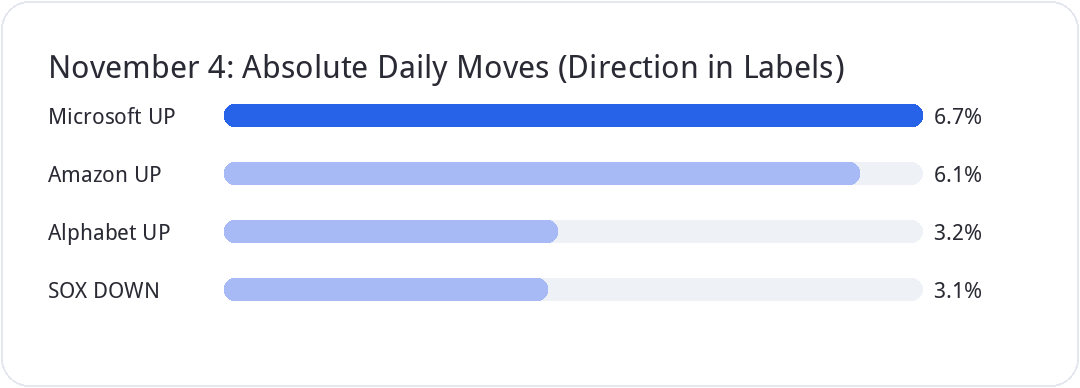
One session cannot isolate the election's impact on each stock. The selloff in oil, lower bond yields and the unwinding of hedges all affected prices. Still, the relative performance is consistent with investors revaluing existing computing capacity against newly planned capacity. The former already has customers and cash-generating assets. The latter may face permitting delays, capital costs and uncertainty over when hardware will be installed. If cloud platforms continue to outperform semiconductors over several sessions, the divergence deserves more attention than a single day's headlines.
Democratic Control Raises Questions About New Data Centres, Especially in Texas
Democrats won both chambers of Congress in the November 3 midterms, creating a divided government. Congressional committees may now pursue hearings and investigations involving electricity bills, water use, data-centre permits and infrastructure financing. However, President Trump retains veto power. An election result is not a nationwide construction ban.
State politics may move more quickly. Democrat Gina Hinojosa defeated incumbent Texas governor Greg Abbott, becoming the state's first Democratic governor in more than 30 years. She campaigned on a moratorium on new data centres, responding in part to pressure on energy costs and local services. She is expected to take office in January 2027. The exact scope of any executive order, its legal basis and the treatment of existing permits remain unresolved. Companies cannot simply assume every proposed facility is now halted.
Power connections, transmission capacity and local permissions already limit where large computing campuses can be built. If new projects slip, deliveries of NVDA accelerators, memory and optical networking equipment could be deferred. The underlying demand may survive, but purchase orders, acceptance milestones and collections may move into later quarters. The risk is especially acute for debt-funded data-centre operators whose interest costs continue even if expected revenue is delayed.
There is another side to that trade. MSFT, AMZN and GOOGL already operate large cloud networks, own customer relationships and have better access to capital. If usable computing capacity becomes scarcer while customer demand remains strong, existing infrastructure may command higher utilization and potentially better pricing. Slower future expansion could also ease capital-spending pressure. Yet the hyperscalers are themselves active developers, so tighter permitting can eventually constrain them too. November 4's stock prices fit this market interpretation but do not prove cloud services have already raised prices.
Claims about the precise share of planned US capacity in politically vulnerable states, or about record credit-default-swap levels, require consistent original data. Without that evidence, the practical watchlist is local permit language, future capital-expenditure guidance and delivery schedules.
NVIDIA and TSMC: A Price Band Is Not an Earnings Guarantee
NVDA remains a central expression of concentrated AI exposure. With capital shifting away from hardware, a predetermined risk plan can be more useful than trying to predict the next rebound. Consider $174–$194 as an observation band, with $174 as a stricter technical threshold. For a hypothetical 10% portfolio position, a sustained break below $174 could justify cutting to 5%, then reassessing only after a credible base develops around $150–$160. Holding above the threshold would support retaining a core position rather than overtrading intraday swings.
These are trading-plan reference levels, not exchange-certified support. Nor can a $186 valuation floor be demonstrated merely by applying a 20–30 times earnings multiple to an unverified 2027 EPS estimate. The EPS denominator can change as shipments, capital expenditures, margins and share count change. A falling forward P/E is not proof that earnings expectations have stopped declining.
TSM retains competitive advantages in advanced manufacturing, yields and customer integration. Even so, it is exposed to the semiconductor cycle and changes in investors' discount rates. The $360–$378 area can serve as the first zone to reassess a staged entry, with $320–$350 as a second, deeper zone. Entering either zone alone is not a buy signal. Look for stabilization in price and volume, a healthier industry order outlook and a consistent fiscal-year earnings denominator before adding.
A mechanical detail matters this week: the SOXX ETF announced a three-for-one forward share split after the November 4 close. Shares trade on a split-adjusted basis beginning November 5. Comparing the unadjusted prices across those dates would create a fake crash. The 3.1% decline in this article refers to the SOX index, not an ETF price change caused by a split.
Microsoft and Amazon Rally, but the Entry Price Still Matters
MSFT and AMZN were two of the clearest beneficiaries of the rotation, each gaining more than 6%. The election may have reduced some policy uncertainty, while oil and bond markets also helped sentiment. These firms have existing cloud revenue, entrenched customers and considerable financial flexibility. Even so, the relative advantage from constrained computing capacity only holds if customers continue to demand more service.
Microsoft's earlier pullback zone around $534 has already been overtaken by the rally. Prices above $600 and $623 can be used as long-horizon scenario references, not management guidance or guaranteed targets. The next test is whether the breakout retains volume support. A sustained reversal below $534 would weaken the case that Wednesday's jump was the start of a durable new trend. Chasing a one-day 6% advance with a full new position is harder to justify than waiting for consolidation.
Amazon's proposed $250–$360 range likewise depends on 2027 earnings assumptions. It does not mean $250 must provide support or $360 will be reached. A controlled pullback that holds the breakout area can offer a clearer risk boundary than repeated gap-up purchases. A complete reversal back into the previous trading range would call the breakout into question.
GOOG moved up more modestly. A projected 2027 valuation range of $299–$449 should only be used alongside updated earnings forecasts. A light position could monitor a future decline toward $270, while an overweight position may pay more attention to repeated failures near $298 and eventual confirmation above $348. META's $580–$630 zone is another possible longer-term staging area, not a promise of value or a universal stop-loss rule.
Intuitive Surgical, Defensive Rotation and Portfolio Risk
ISRG does not face the same funding-chain risks as a new AI data centre. Its economics rely more on procedure growth, installed robotic systems, recurring instruments and hospital budgets. The $470–$500 range is a useful upper trading reference. Sustained price and volume confirmation above $500 would suggest buyers are accepting a higher valuation. Repeated failures there, or a break below $458, would warrant another review of tactical exposure.
Consumer and healthcare shares also attracted post-election buying as investors speculated about future healthcare and food assistance policies. Those expectations have not yet become recognized earnings. Defence companies face budget bargaining risk; softer short-term catalysts do not automatically imply falling long-term orders. In each case, policy headlines, bookings and earnings revisions should be assessed separately.
For the next few weeks, the most revealing signal is whether strength broadens from cloud platforms back into semiconductors. In a constructive scenario, Texas restrictions are narrow, project timelines remain intact and SOX stabilizes alongside cloud leaders. In a mixed scenario, hyperscalers remain strong while hardware and leveraged operators struggle with financing and permitting uncertainty. In a bearish scenario, project delays turn into weaker procurement schedules, credit spreads widen and pressure spreads from individual suppliers into the wider technology market.
For concentrated technology portfolios, start by assessing position sizing, potential short-put assignments and the maximum drawdown the account can absorb. Cutting a position, buying protective puts or structuring collars are possible responses, but each comes with trade-offs. A broad-market rally can coexist with a bear market in some holdings. The key distinction is between businesses collecting cash from operating capacity and those still waiting for new projects to come online.