The 10-Year Backed Off. Cyber Still Needs a Floor.

US Stocks · Options · News · Views
The press conference did the damage. Nasdaq barely finished flat.
Wednesday's flush started in the Warsh presser, not in the 25 basis-point hike. Futures had already priced the move. Indexes hesitated on the statement, then sold off when the chair called inflation too high for too long. A late bounce repaired some of it. SPX closed 7,552, down 0.4%. The Dow dropped 1.2%, with financials and cyclicals doing the damage. The Nasdaq was essentially unchanged. Tech and health care eked out small gains. Energy, financials, and materials lagged.
Philadelphia semis opened higher and faded, then clawed some of it back into the close. SOXX finished 502, a modest lift from Tuesday's 499, after 510 high and 497 low. 486 is still underneath. SMH closed 546. META closed 673 and remains one of the more resilient large-cap tech names, but it did not trade as its own event after the meeting. Mark the tape. Do not treat a press-conference bounce as a trend reversal.
The hike was expected. The statement deleted the supply-shock alibi.
The Committee raised the funds target 25 basis points to 3.75% to 4.00% on a 12-0 vote. First hike since 2023. The statement was short. Activity is expanding at a solid pace. Domestic spending has been resilient. Productivity growth is strong. Capital investment is robust. Job gains have kept pace with the workforce. The unemployment rate has changed little. Inflation remains elevated. The action is meant to support a timelier return to 2%.
The real edit is attribution. The prior statement still hung part of high inflation on supply shocks, including energy. That language is gone. The Committee is more willing to treat the pressure as demand-side and more entrenched, not as oil and bottlenecks that fade on their own. Warsh put price stability first beside full employment and talked discipline, not a one-meeting decision. Asked whether financial conditions are already restrictive, he would not call them that. One hike does not close the door. He also refused to frame the move as risk management. The line was resolve to get inflation back to target. The Fed cannot pin a single energy price. Its job is to stop second-round and third-round effects. What gets squeezed is demand and credit, not the wellhead.
August retail sales rose 1.2% against a 0.8% expectation after a revised 0.5% decline in July. The control group rose 1.4% against about 0.4%. These are nominal prints. They are not inflation-adjusted. Nonstore sales bounced from a deep July drop, and seasonals likely flattered August. The dollar total looks strong. Purchasing power may not have thickened with it. That is the picture Warsh wants: households are still spending, and prices are not falling fast enough.
The median holds. 2027 is split both ways.
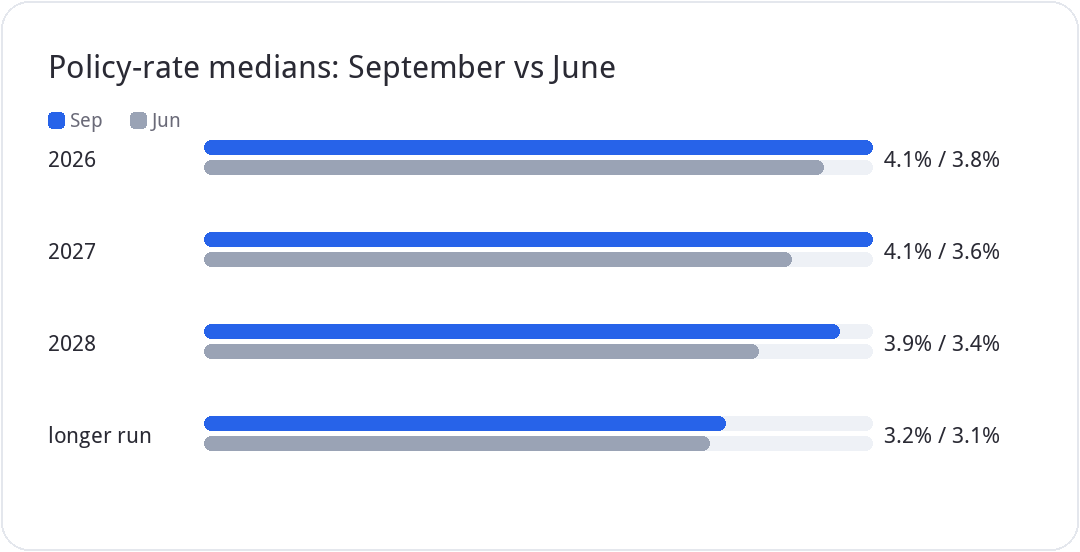
Warsh again submitted no dot. Eighteen participants did. The 2026 median is another 25 basis points, to 4.1%. Twelve see one more hike this year. Four see two. Only two see the cycle stopping here. The 2027 median is still 4.1%, which reads as a hold after this year's extra move. Do not read that hold as a dovish turn. In June the medians were 3.8% for 2026 and 3.6% for 2027. Both years now sit at 4.1%. 2028 rises to 3.9% from 3.4%. 2029 is 3.6%. The longer-run rate moves to 3.2% from 3.1%. Unemployment is 4.1% from 2026 through 2029, 4.2% in the longer run. PCE is 3.7% in 2026, 2.3% unchanged in 2027, 2.1% in 2028. Core PCE is 3.4% in 2026, 2.5% unchanged in 2027, 2.2% in 2028. Growth was revised up, unemployment down, inflation up. The whole rate median is higher than June.
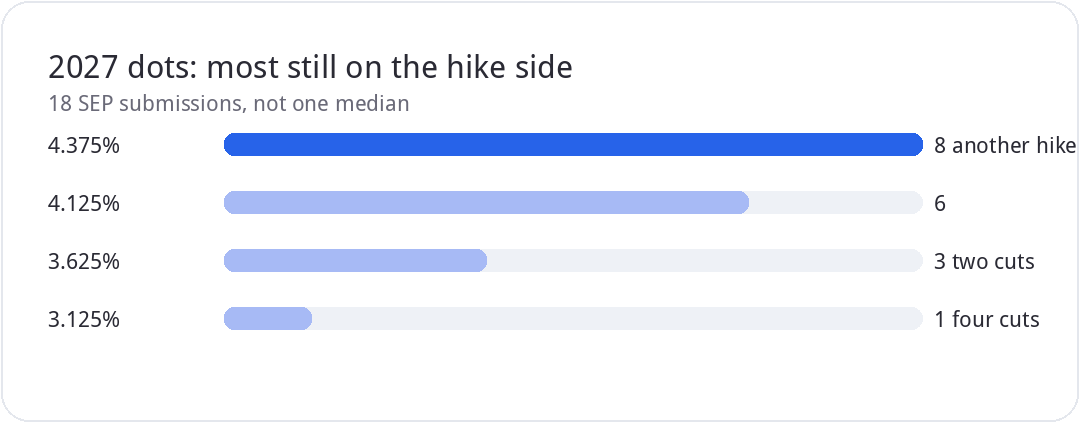
A median is an average, not a settled committee view. For 2027, eight dots sit at 4.375, another hike. Six sit at 4.125. Three sit at 3.625, two cuts. One sits at 3.125, four cuts. Those four are a long way from the hawk cluster. The path is torn in half: one group thinks 4.1% is not enough, another is already drawing easing. Calling the hawk camp finished is a misread. Calling another 2027 hike a lock ignores the four low dots. The 10-year could fade tonight because the 2027 median stops adding hikes, not because the page agrees. If the next SEP pushes those eight 4.375 dots higher, the long end comes back.
The 10-year paused. That is not a green light for growth.
The 10-year tagged 5%, then reversed after the decision toward 4.95%. That is a bond-market positive. The tape had been pricing more 2027 tightening after the 2026 hike. A median that holds 2027 capped the melt-up in yields. Growth and tech were not hit with another long-end whip, which is why semis could bounce into the close. Deutsche Bank's history — that the 10-year often rises more than 100 basis points after tightening starts — can sit on the shelf for now. It is not void. The invalidation is simple. If Brent runs from above 100 toward 110 to 120, this hike path cannot cap inflation, the dots change, and the 10-year returns.
Warsh tied the recent yield rise to three things: a strong economy, capex lifting the demand for capital, and geopolitics. Agree or not, trade the result. A faded 10-year is a pause, not a reversal. SOXX is still coiling in a triangle. Breaks near the apex that grind through at 0.3% or 0.5% a day are less reliable. Confirmation needs a gap and volume, not a slow rub of the line. 486 remains the regime line. 502 is only back to the middle of the range. SPX held near today's low. Treat that as near-term defense. Lose today's low and the index weakens again. Clear today's high before calling it strength. The post-meeting bounce is not permission to add.
The cyber narrative is hot. The supports are thin.
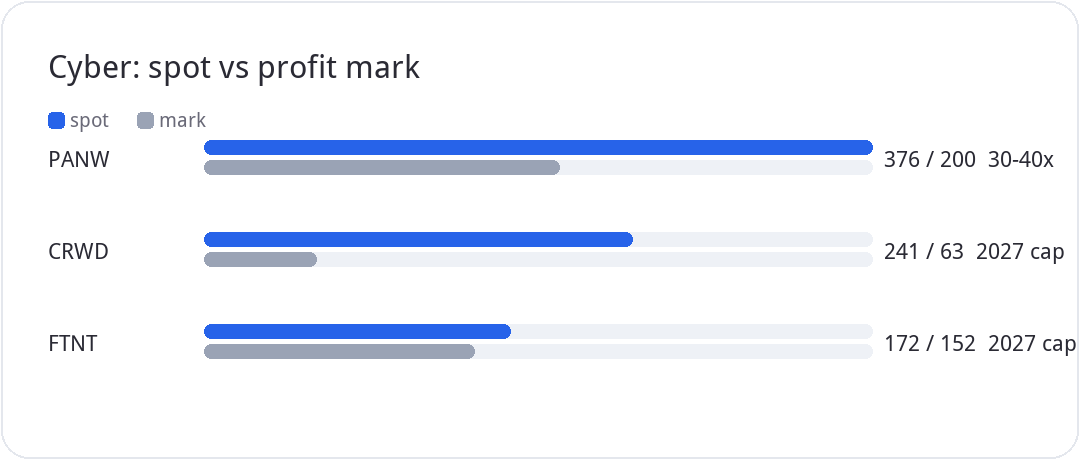
After the meeting the tape rotated back to AI. Chips remain the main line. Inside software, cybersecurity is the sleeve that got amplified. The weekend AI-threat talk filled the bid on Monday. CRWD jumped about 14% and closed near a then-record. PANW gained about 13%. FTNT gained about 9%. Options and retail piled in. Wednesday the three names were still near the highs: PANW 376, CRWD 241, FTNT 172. Volume is still above average, but it has been shrinking for several sessions. The heat is still there. If volume drops below average while price keeps rising, the tape is set up for a volume-price top divergence.
Sell-side has not rewritten growth to 25% or 35%. PANW on 30 times to 40 times and about 15% five-year compounding maps 2028 upside around 197 to 200. Spot 376 already pays for a much faster growth revision. Overhead is empty. So is support. CRWD is on a higher 50 times multiple because compounding is marked near 26%. The January 2027 forward map is about 37 to 63. It has the heaviest retail participation and the fastest lift. Near support is 223 to 229, then 205 to 216, then 197. FTNT maps 102 to 136, with a 2027 cap near 152. Less extreme than the other two, still rich. 160 to 165 is thin. A break of 142 opens about 30% of air.
The narrative can keep running. The machinery rhymes with nuclear, memory, and data-center tapes: when everyone stares at the same sentence, heat expands and contract and capex updates lag. Sell-side has nudged estimates. It has not lifted growth far enough to fill 376 and 241. If buy-side models are more optimistic, that book is not public. Treat it as an inversion, not as earnings that already printed. If the position is on, use the supports as profit stops. No topping pattern means later buyers can still push it. If it is not on, do not chase the first clip into a record with no floor. Let volume prove the heat is still there before deciding whether this is still a range or already a trend.