IREN Jumps 20%, but Its $9 Billion Is Not All Cash

US Stocks · Options · News · Views
Chips rebound while the equal-weight S&P 500 falls
The S&P 500 and Nasdaq rebounded on Friday, November 6, but participation remained uneven. SPY, which tracks the market-cap-weighted S&P 500, rose 0.31%, while RSP, which holds the same stocks at equal weights, fell 0.38%. Eight of the 11 sector ETF proxies closed lower, with technology leading the gains. Small-cap ETF IWM also rose 0.99%, showing that the recovery extended beyond large caps even as different parts of the market moved out of sync.
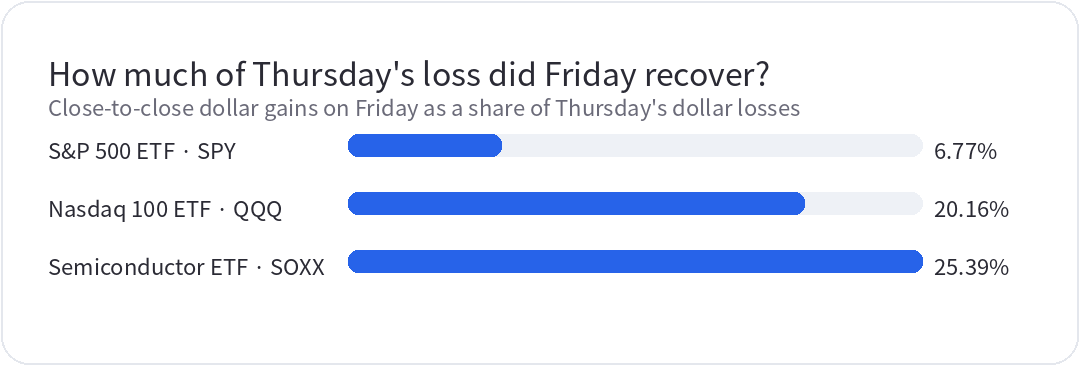
QQQ closed at $656.10, up 1.40%, and semiconductor ETF SOXX at $136.53, up 3.51%. Those were sizable gains, but they recovered only a fraction of Thursday's damage. Comparing each ETF's dollar gain with its prior-day dollar loss, QQQ recovered about one-fifth, SOXX about one-quarter, and SPY less than one-tenth.
Volume eased from Thursday's selloff, but the rebound was hardly without volume. SPY and QQQ both traded less than during the panic session, yet remained above their respective preceding 20-session average volumes. VIX fell from 28.18 to 25.64, still well above its November 4 level of 16.61. Implied volatility in S&P 500 options had not returned to its pre-selloff level.
SOXX reached $140.21 intraday before fading to $136.53. Watch whether a pullback holds near Friday's $133.80 low, then whether a move above $140.21 can stick. Inside that range, wait for confirmation.
QQQ also gave back part of its advance, closing at $656.10 after reaching $664.52. A reclaim of $664.52 followed by a successful retest would add conviction to the rebound; a break below Friday's $653.99 low would weaken the case for follow-through. These observed highs and lows are reference points, not guaranteed support or reversal targets.
Payrolls offer no relief on funding costs
US nonfarm payrolls rose by 165,000 in October, with the two preceding months revised up by a combined 84,000. Unemployment was 4.1%, while average hourly earnings rose 0.4% month over month and 3.1% year over year. A sudden labor-market slump and immediate policy easing remain poor assumptions on which to base a trade. The number of people working part time for economic reasons also increased, however, so one report offers no blanket all-clear for the labor market.
Treasury yields offered no relief for the rebound. In the official daily series, the two-year yield rose from Thursday's 4.46% to 4.51%, and the ten-year from 4.84% to 4.86%. The curve uses indicative quotes around 3:30 p.m. Eastern, rather than prices at the equity close.
With short-term yields moving higher, long-duration construction projects received no obvious break on financing costs. AI computing operators spend before they deliver capacity, leaving revenue conversion and financing terms central to the investment case. A stock-price rebound alone is no reason to relax scrutiny of funding risk.
IREN's revenue surges as construction consumes cash
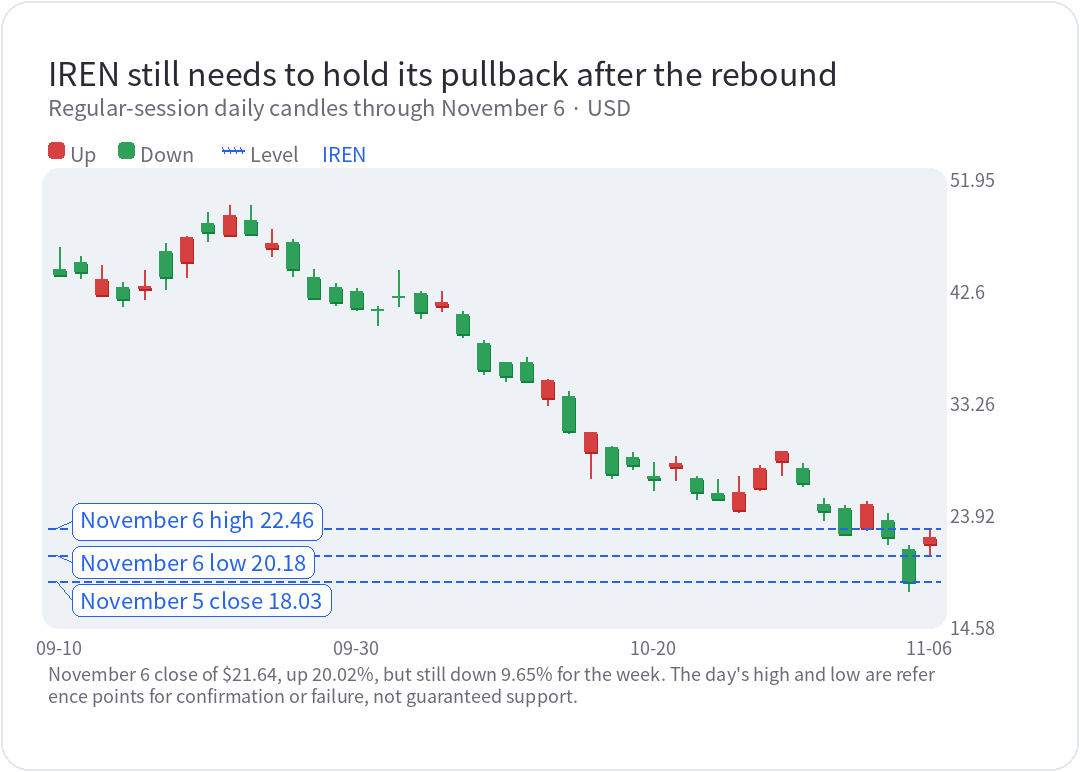
AI cloud operator IREN closed at $21.64, up 20.02%, almost recovering Thursday's dollar loss while still ending the week down 9.65%. Watch for buying near Friday's $20.18 low, then for a decisive break above the day's $22.46 high. If a pullback fails to hold, a 20% gain does not make the entry attractive by itself. Even if the price stabilizes, delivery and funding milestones still need to come through before confidence in the rebound increases.
The business is growing quickly. For the first quarter of fiscal 2027, ended September 30, 2026, IREN reported total revenue of $228 million and AI cloud revenue of $200 million, up 182% from the preceding quarter. That included $65 million of lease revenue, a category absent in the previous quarter, so the full increase cannot be treated as like-for-like growth in service revenue.
Cash generation has yet to catch up with expansion. IREN reported a quarterly GAAP net loss of $263 million and operating cash flow of $529 million, including a positive $645 million working-capital movement related to deferred revenue. That movement cannot all be labeled newly received prepayments, and operating cash flow is not operating profit. Two equipment and infrastructure cash-payment lines totaled $4.824 billion, far exceeding operating cash flow and leaving construction dependent on external funding.
Some of IREN's $9 billion cannot yet be spent
IREN's $9 billion represents a combination of funding sources as of the end of September. It includes cash and equivalents, restricted cash, undrawn committed GPU financing, and contracted customer prepayments not yet received. Cash and equivalents were $3.522 billion, and restricted cash was $2.256 billion. The headline total is not a bank balance available to spend at will; restricted-cash releases, financing drawdowns and customer payments each have their own timetable.
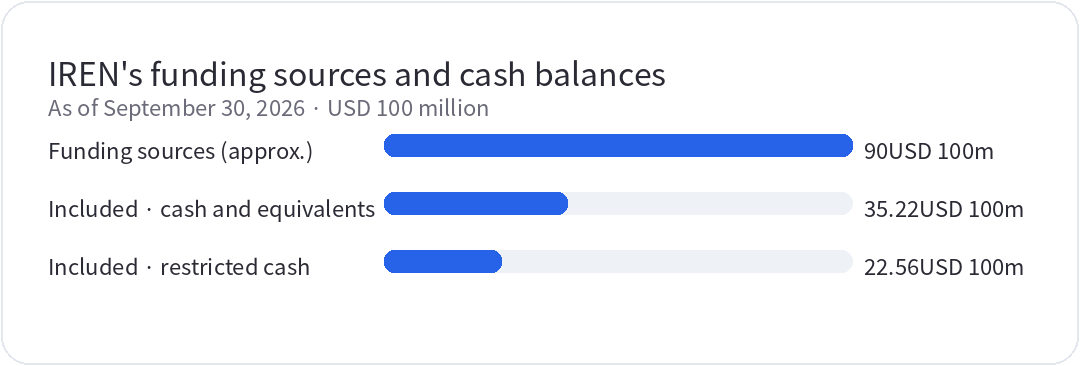
The two cash balances are included in the funding total, not additional funds. The total also includes undrawn financing and contracted prepayments not yet received, with drawdown and release conditions.
IREN says funding has been arranged for the 0.3-gigawatt program supporting its annualized revenue run-rate target of more than $4 billion, subject to financing drawdown conditions, escrow-release conditions and availability periods. Its remaining fiscal 2027 capital-spending plan, measured from the end of September, is approximately $15 billion. A separate financing target of approximately $6 billion supports further expansion and depends on market conditions. Do not simply subtract the $9 billion funding basket from the $15 billion spending plan and call the resulting $6 billion an unfunded hole in the existing $4 billion run-rate program.
The run-rate target has also slipped from the end of 2026 to January 2027, with a possible further delay to the end of February. It annualizes revenue based on factors including commissioned GPUs and contract pricing; it is not GAAP revenue already recognized. Actual revenue may take several more months to ramp after equipment commissioning, testing and customer acceptance.
Watch for completed acceptance, receipt of contracted prepayments and actual financing drawdowns. If construction payments remain ahead of delivery and collections, even a large funding package will not automatically eliminate the intervening cash pressure.
Demand for older GPUs does not guarantee lease renewals
Bloomberg reported Friday that Microsoft had been reducing some older-GPU capacity rented from Oracle over recent months and had chosen not to renew. Oracle said demand remained strong for earlier-generation GPUs. The report concerns the suitability and renewal of some capacity; its limited scope does not establish widespread AI contract cancellations or a collapse in aggregate AI demand.
IREN's post-quarter contracts offer a counterpoint. Prepayments under a new five-year contract cover 90% of the estimated capital cost of the related GPUs, while a new H100 contract was priced at twice the level of a specific previous agreement. Older hardware still attracts customers, but those favorable terms belong to particular projects and contracts. They cannot be applied to every GPU, and future orders may not secure the same prepayment terms.
A broader index recovery still needs RSP and the sector ETFs to participate, while IREN needs to connect contracts, delivery and usable cash. Until pullbacks hold the key price levels, a large one-day gain is no reason to chase the stock.