Breadth Improves, but Tech Still Needs to Prove Itself

US Stocks · Options · News · Views
Market View: The Rally Is Spreading Beyond Tech
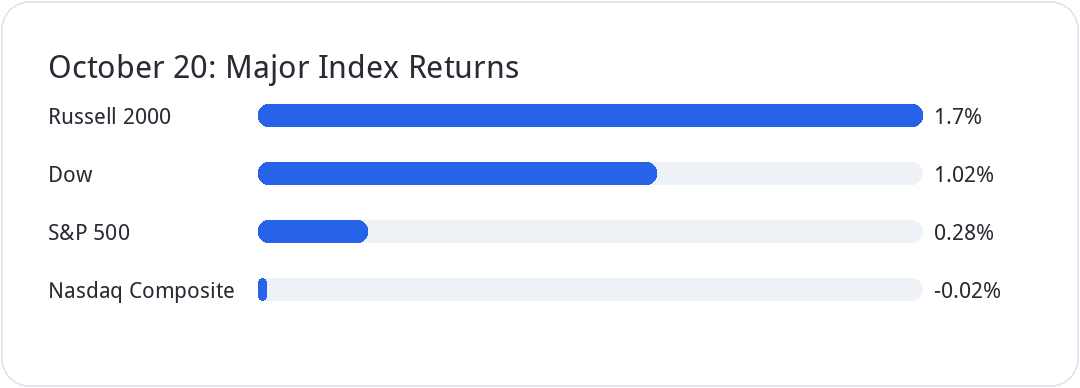
U.S. stocks rotated on October 20. The Dow gained 1.02%, the S&P 500 rose 0.28%, the Nasdaq slipped 0.02%, and the Russell 2000 added about 1.7%. Healthcare led the market while technology weighed on the Nasdaq. Money moved beyond mega-cap tech into healthcare, industrials, financials, and defensive groups.
That was the opposite of the prior session, when technology led the rebound. Market breadth improved, but semiconductors and large-cap tech did not join the move. The AI trade has not regained a clear direction. The next test is whether participation keeps broadening and whether tech can attract sustained buying after earnings.
SpaceX: Strong Results, but Discount the Long-Term Target
SpaceX (SPCX) reported third-quarter revenue of about $14.6 billion, up 161% year over year. Net income reached $4.4 billion, and adjusted EBITDA was $8.8 billion. Growth came from connectivity and the expansion of its AI-related business. The quarter was strong on both growth and profitability.
The bigger question is the long-range forecast. Management discussed reaching $500 billion to $1 trillion in annual recurring revenue by the end of 2027, alongside a major expansion in AI compute capacity. That target sits far above the current revenue run rate and assumes very high utilization, pricing, compute deployment, and demand. It can lift sentiment, but it should not be treated as a base case. The more a valuation depends on an aggressive forecast, the more sensitive the stock becomes to execution risk.
A potential SpaceX–Tesla combination also came up, but there is no formal transaction structure to value. Without exchange terms, cash consideration, or governance details, prediction-market odds cannot substitute for a deal proposal.
ISRG and NFLX: Beating Estimates Does Not Guarantee a Rally
Intuitive Surgical (ISRG) generated $3.05 billion in third-quarter revenue, up 22% year over year, while adjusted EPS reached $3.00. Da Vinci procedure volume grew about 14%, and the company placed 546 systems during the quarter. The operating business remains strong, but the company also recorded a $450 million antitrust settlement charge. The after-tax impact reduced GAAP EPS by about $0.99. Investors have to weigh the charge, the growth outlook, and the valuation together.
The company expects procedure growth of about 14% to 15%. That is healthy, but slower than its earlier growth profile and may not justify the stock's historical premium. A 25–35 times forward-earnings range offers one valuation framework. The watch zones discussed are $302–$306 for a longer-term add and $370–$405 for a more aggressive entry. These are different risk setups, not unconditional buy signals.
Netflix (NFLX) reported about $12.87 billion in quarterly revenue and adjusted EPS of $0.87. Its fourth-quarter revenue outlook came in slightly below expectations, keeping attention on viewing time, content strategy, and slower growth. The question is not simply whether the quarter beat estimates; it is what multiple investors will pay as growth cools. A plan to build a position below $77 still needs price stabilization or a clearer base. A post-earnings drop alone is not a bottom signal.
The Next Catalyst: META's CapEx Outlook
The next focus is Meta's (META) commentary on 2027 capital spending. The largest technology companies spend far more than SpaceX. Another increase in planned investment could reinforce AI infrastructure demand, but it could also raise questions about free cash flow, financing, and returns on invested capital. For semiconductors, customer budgets and the time it takes for spending to turn into revenue matter more than demand headlines alone.
The market's message is straightforward: breadth improved, technology lagged, and capital rotated between sectors. Bulls need to see sustained buying in tech after earnings. Bears need defensive leadership to persist. One session of gains or losses is not enough to confirm a trend.