The S&P No Longer Moves With the Market, and Hedge Funds Won't Add

US Stocks · Options · News · Views
The tape was easy. The structure was not.
Monday was a broad up day. All four major indexes rose, and the Nasdaq made another record high. Inside the S&P 500, 317 names rose and 183 fell. Ten of 11 sectors closed green. Real estate was the only one down.
The information content was small. The structure did not change. Money is still crowded into the technology and semiconductor names with the hardest earnings. The S&P index itself is a worse and worse stand-in for "most stocks." Hedge-fund books say it plainly: gross leverage is falling, the technology long was added only a little, and every other sector was a net sale. If you already own the AI and semiconductor cycle, let the tape carry it. If you are not in, do not chase a new high. Look for names that have not started.
ISM services: mixed, and prices are hot
The September ISM non-manufacturing PMI fell from 55.4 in August to 54.9, a touch under the 55 consensus, still above the 54.1 average of the past 12 months. The business-activity index dropped from 61.7 to 56.5. New orders weakened with it. Those two lines did most of the dragging.
The other side ran hot. The prices index rose from 72.6 to 74, above the 73.3 consensus. Employment, after two months of contraction, moved back above 50, from 47.8 to 50.1, better than the 48.8 consensus. Thirteen industries reported growth, one more than in August. Four reported contraction, one fewer.
Services are still expanding, at a moderate pace, and slower than the S&P Global services PMI. Higher prices and employment back in expansion are not friendly for rate hopes. The indexes ignored the print. It is background, not the trade.
The S&P has come unhooked from almost everything
Trying to read "is the market fine" off the S&P 500 gets more confusing the longer you look.
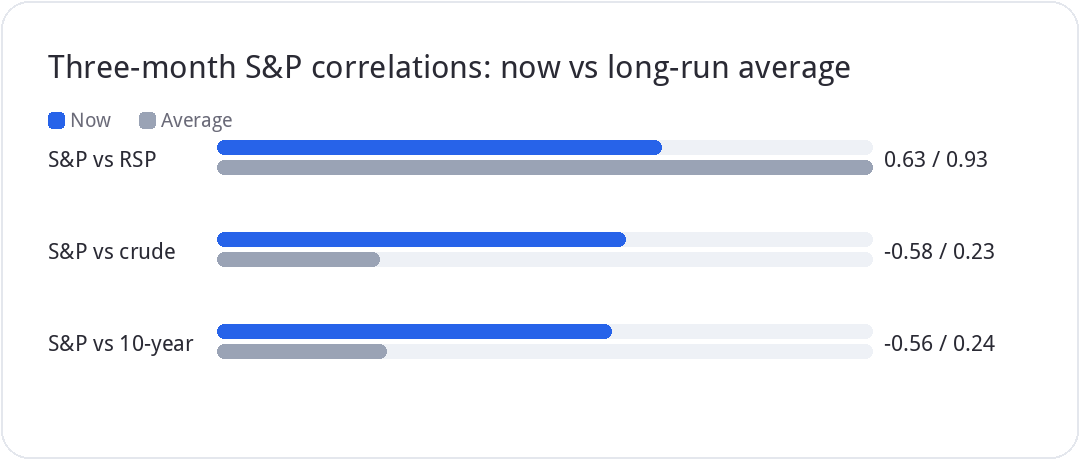
The index and the equal-weight book have diverged. The three-month realized correlation between the S&P 500 and equal-weight RSP fell to 0.598 on September 22, a 15-year low, four standard deviations under the 0.93 long-run average. As of Friday it was only 0.63. The S&P is sitting near a high. The equal-weight index had already given a lot back. That is why the Nasdaq can print records while consumer stocks you actually own keep falling.
AI and the rest of the index have split. Since August, the correlation between an AI portfolio and the S&P 500 excluding AI constituents is the lowest, and the most negative, on record.
The macro anchors have slipped too. Three-month realized correlation with crude is -0.58, not far from June's record -0.62, against a 15-year average of +0.23. Correlation with the 10-year yield is -0.56, versus a June low of -0.64 and an average of +0.24.
Sectors have stopped moving with the index. Staples, energy, utilities, and health care all have 63-day correlations with the S&P at zero or below. Staples and energy are at 20-year lows. Bank of America's equity-derivatives desk says uncertainty keeps repricing AI and policy winners and losers, which has crushed both cross-industry and within-industry correlation. Their chart puts stock-to-industry correlation over the past 12 months near 0.1, below the 5th percentile of data since 1991. Breadth is ugly too: the five-day average of S&P members at a 52-week high minus those at a 52-week low has fallen to -25%, the worst in 18 months.
The mechanism is simple. The good AI-linked stocks are rising. Everything unrelated is either ignored or still falling. Index weight sits in the first group, so a new index high and a falling majority can exist at the same time. Do not use the index to grade a single-stock position. Ask whether that stock is on the side where estimates are still being revised up.
Hedge funds cut leverage and sat on technology
Last week, net leverage in US fundamental long-short books fell for a third straight week, another 2.2 percentage points to 46.4% from 48.6%. That is the lowest since around the April 2023 low, near a five-year low, the 2nd percentile. The long-short ratio fell 1.9% to 1.57, the 1st percentile on a five-year look and the 0th percentile on a one-year look. The lowest. The market rose. The aggregate long did not.
They did buy something. Goldman data show US technology was the only sector with net buying in September, and the highest net-buying share since February 2023. Cyclicals, defensives, and consumer discretionary were all net sold. The technology buying was not a chase. It was enough not to fall behind a market that kept pushing technology higher.
There is almost no conviction to be long the S&P as a whole, and no direction. The book is sitting on the technology names with the strongest earnings, adding a little, waiting to be carried. Why is the money piled there? Because inside the S&P's earnings, technology, AI, and semiconductors are doing the most of the lifting, and the revisions are the fastest. Earnings come first. The buying follows. The other sectors are not the hot trade, and a weak tape does not give them much to say.
If your book looks like that hedge-fund book, you are the one being carried. If there is no add, let the existing position work. Do not buy weak groups just to "own the other sectors."
NVDA, MSFT, TSM
NVDA finally closed at a record high. That is an attitude, not another session of leaning on the old high. Nearby support is 219 to 232, the gap it jumped through. The valuation case has not been expensive: the stock is only around 230 to 240. Even on 20 to 30 times, with the growth rate cut in half, the forward range into the fiscal year ending January 2028 is 251 to 377. The midpoint, 314, is still roughly 20% to 30% of room. Whichever forward set you use, it is not expensive. There is no fresh negative. Ignore the small technical noise and keep the position.
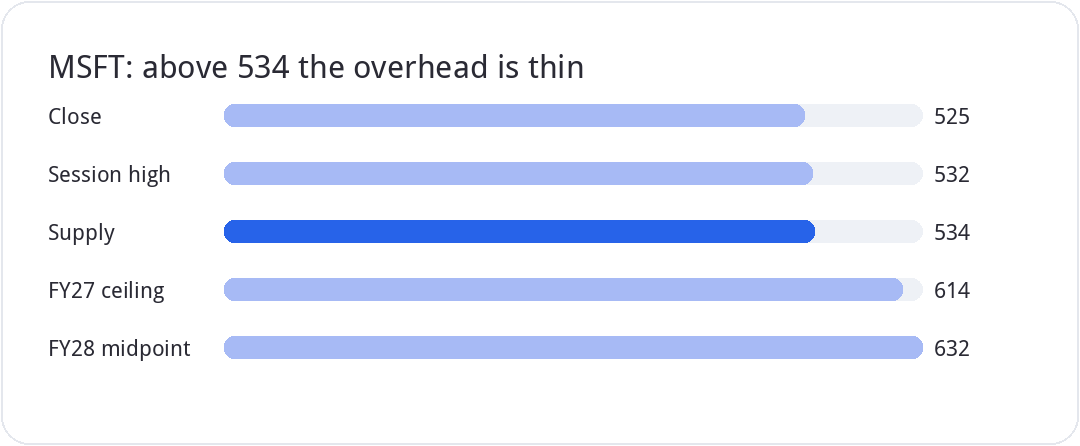
MSFT closed at 525, a recent high, with a session high of 532. There is one medium supply zone overhead. Through 534 there is almost nothing. The pocket from 534 to 550 is small enough to ignore. The medium-term look is 600 and above: a fiscal-2027 ceiling, year ending June 2027, of 614, and a fiscal-2028 midpoint, year ending June 2028, of 632. This is not a high-beta name. It will not be fast. Hold it and let another 20% or so come out. That is a reasonable path.
TSM printed a record high on three straight days of stepped-up volume. That is a strong-stock pattern. Leave it alone. The 2027 forward range is 321 to 593, midpoint 457, and the price is already through the midpoint. It has run ahead of itself. If you are in, do not touch it. If you are flat, it is a hard buy: chasing, then giving back even to 400, hurts. The only clean add is a pullback. The stock's own history is full of them. If the fundamentals are still intact on the way down, that is when to add. What was not bought is not bought. This semiconductor cycle is not finished.
The other names
SpaceX rose on rising volume for a second day and looks to have cleared the prior shelf, through 150 and toward 170. The chart is strong. It has not traded for a year. Many zones have never been tested, so support and resistance are guesses. The area near 100 was tested once. 150 has been tested several times. You only learn whether 150 still matters after price comes back and steps on it again. No clean technical map yet. The speculative bid is picking up, and TSLA is still working higher.
TSLA is around 380. The closer it gets to 415, the more the offer matters. Until it gets there, hold it and do nothing.
AMZN and GOOGL are still reasonable entry zones at the current price. MSFT has already started and has run. META was not bought on the lows, and after a 40% move it is hard to start. If these are names you want, the quiet part of the range is when the position gets built.
AVGO is unchanged. It can be bought around here. A break of 324 is the hedge. 324 is the watershed: through it, institutions are marking down the growth rate in advance. If it holds and the larger trend is still turning up, there is no reason to sell in a hurry. The closer it trades to 324, the smaller the stop and the better the risk-reward, provided the break is actually sold and not sat through.
The Philadelphia semiconductor index is still chopping sideways. SMH barely moved.
Three paths
Bullish: the Nasdaq keeps closing at highs, MSFT holds above 534, and NVDA holds the 219 to 232 gap. Money stays on the technology line where estimates are still rising.
Neutral: the S&P grinds near the highs, correlations stay broken, and semiconductors chop. Holders let the position work. AMZN and GOOGL, the names that have not started, get built slowly.
Bearish: AVGO loses 324, which is the market pricing a slower growth rate. Hedge first. If TSM pulls back, add only after the fundamentals still check out. Do not add size at the high.