Chip earnings leave little slack as AMD leads

US Stocks · Options · News · Views
The four indexes bounced; treat it as triple-witching noise first
All four indexes closed higher Thursday, with Nasdaq in front. SPX finished 7,638, up 1.1%. Nasdaq closed 26,418, up 1.7%. The Dow gained 0.6% and the Russell 0.5%. About 9 of 11 S&P sectors finished green. Technology rose roughly 2.2% and carried the tape. Financials and staples slipped, and communication services stayed soft. The tape looked clean. Stability is still poor. The past few sessions have already alternated up and down days. Friday is triple witching, so Thursday’s volume and options covering will mix. Treat this green candle as part of settlement-week noise and wait for direction. Tomorrow can be noisy in the process and quiet in the result.
Initial jobless claims for the week ended September 12 printed 196,000, below the 208,000 forecast and the 206,000 prior. Continuing claims fell to 1.73 million, below the 1.78 million estimate, with the prior revised to 1.769 million. The labor print gives the Fed a little more room to watch inflation. It does not authorize reading the rally as a trend.
The Philadelphia Semiconductor Index rose 3.1%, with 29 of 30 members higher. SOXX closed 519, up 3.4%, after a 520 high and a 515 low, and stalled again near the descending trendline. That is almost the same tap as last Friday. Last Friday’s close was around 527. Monday then sold 5.6% on SOXX after the weekend talk about slowing AI development. The one-day-up, one-day-down tape is not over. The mega-cap group lifted with it: AMZN up 2.1%, MSFT up 1.5%, GOOGL up 1.3%. NVDA closed 219, up 2.5% versus the prior close, but the session only traded 217 to 220. Volume did not expand.
The index cannot rally if chips fail
Wall Street has marked semiconductor and equipment earnings as excellent, so the tape has to trade them that way. For the index to go up, chips at least have to hold. A deep chip selloff with the rest of the market carrying SPX higher does not have a fundamental path right now.
The five largest companies already account for 27% of S&P 500 NTM EPS, a record. The 2027 growth math is more extreme: semiconductors plus equipment contribute 62% of predicted S&P EPS growth. One industry is carrying about three-fifths of the expected increase. On current EPS, the 2026 trading range for that forward map sits roughly 7,000 to 8,500. Without chips, who delivers the top of that band? If the index is to rise, chips cannot fall. If the index is to rally hard, chips have to push with it. A solo chip drawdown leaves too little elsewhere to support the forecast.
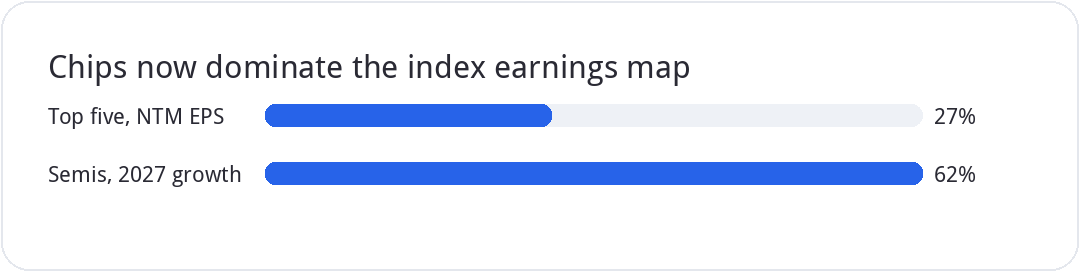
The margin for error is thin. If actual profits miss those forecasts, the cut will hit the index fast. Anyone still running a heavy semiconductor and AI book, watching quarter by quarter, should treat each print as the test for staying in the trade. When the high-growth forecast ends is still unclear. That is why the weekend “slow AI” talk hit so hard: if the spenders blink, this consensus EPS layer has to be marked down. META and NVDA then said they disagree with slowing, and the tape could fill Monday’s hole.
Capex is still the base of the model. Bank of America has taken 2027 hyperscale growth down to the mid-30s, a clear slowdown from 2026’s near-doubling, and a touch above Goldman’s earlier 31% frame. A small cut, not a collapse. The spenders are still borrowing to put money into chips. Until the four mega-cap names announce 2027 capex slowing much more than consensus, the model still stands. Calling a sharp slowdown before they say it is a guess.
SOXX revisiting the 655 prior high remains the base case in this cycle. Spot is 519, so 655 is still a gap. 655 should not be treated as the cycle top. The path is the hard part. September and October are noisy, November brings the midterms, and the AI bill from three senators is still in the drawer. It is unclear whether that is a detailed rule set or a framework, and when it hits the table. That is the near-term uncertainty.
Chips have to work or the index cannot hold. The road can still dig a hole first and take months to get back to the high. Hedge funds need swings; they do not want a 10-day one-way melt-up. Index funds and mutual funds are a different book. Thursday’s gain left SOXX in the 510 to 520 box. The range did not open. Do not mark the green candle as a breakout.
QQQ is stuck at 724; IWM is no help
QQQ is still 702 to 724. It closed 717, high 718, and never reclaimed 724. Only through 724 does momentum get a look at the 734 area. Overhead supply is still there. Thursday’s volume is at least half triple-witching options versus stock, not a confirmed trend change. The setup is neutral. Do not read the green bar as a run at the old high.
IWM is weaker. 288 already broke, and the three-month head from June is in place. Small caps, with a heavy financial and fintech mix, cannot help the tape for now. It closed 285 after failing 288 intraday. 301 is still about five points away. If IWM gets there, the other indexes are likely already near their highs. Russell is the laggard.
Chips are still a step short. A gap on volume, or a large bullish candle that throws the trendline, would raise conviction. A quiet grind through the line should be discounted. Friday can use settlement volume to step higher, or it can just chop. A low open that rebounds, a midday fade, and a flat close would all fit. Futures already leaked a little. That is not the cash open. Unless the session goes one-way strong or one-way weak, treat the whip as covering and do not chase each print. Add only if a real break or one-sided positioning shows up.
AMD is leading; Meta has to repair the breakout
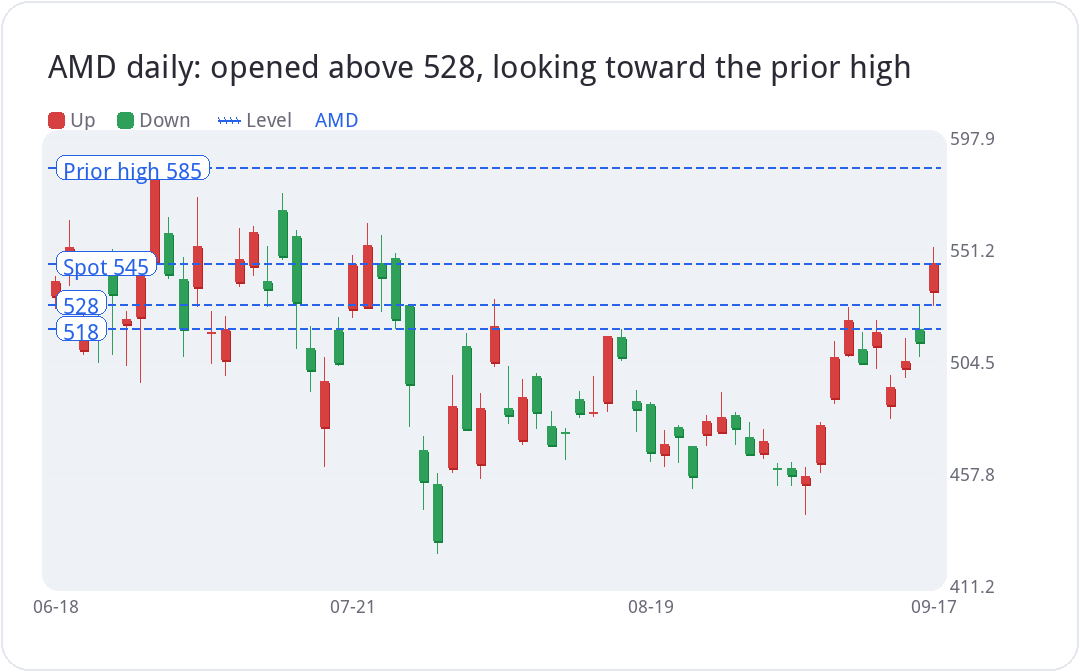
AMD was the cleanest structure in the semiconductor complex today. It opened 534, gap-opened above 528, held 528 on the low, printed 551, and closed 545, up 6.4%. It is already above 518. The technical map looks to the prior high around 585. It is stronger than NVDA. Volume expanded out of the launch zone and the stock has kept lifting. Whether SOXX actually breaks will depend first on whether AMD can finish this uptrend.
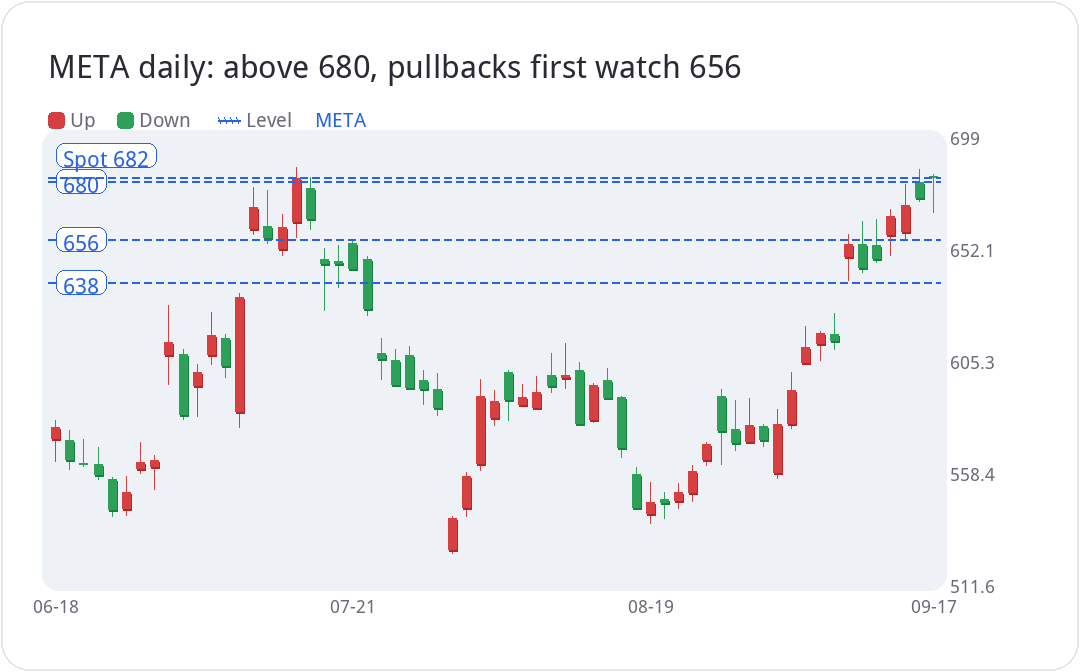
META opened 682 and closed 682, confirming 680. It sold to 667 intraday and buyers filled the dip quickly. After 680 the structure is on the right side: higher lows, higher highs. Waiting for the 500 long-term pocket is not the live map. The old 500-to-700 idea of buying closer to 500 has expired for anyone still uninvested. What remains is cost basis, not whether an entry still exists.
A confirmed break is not a one-way melt-up. A large-cap name rarely trends in a straight line. Daily RSI is overbought and stacked with a bearish divergence — a reset after the run, and it has to cool. Two ways to repair: extend first, then pull back, or pull back first, then resume. Direction is still up. The old 638-to-608 band was too wide; split it. 656 to 680 is the upper pullback zone. Holding 656 is strong. 638 is the line between a repair and a downtrend, not a normal dip. Today’s 667 low already tagged that 656-to-680 band. The overbought/divergence set is not finished, so another pullback is likely — either up-then-down or down-then-up. If the name is still in play, look for that band. Do not chase the first print at an overbought high.
Google and Amazon already offered their longer-term entries on the way down. Anyone who missed them should not wait for those lower levels to return. After the second-quarter prints, the four mega-caps do not have a large fundamental crack. MSFT is still a long coil under resistance. It has not broken down, but volume is too light for it to be the tape’s trade, so wait. The TSLA swing map is unchanged: 331 is the short-term look, 315 the range floor. Spot is 366, so those are rules underneath, not the traded price. Decide whether the 315 stop, or a tighter 331 stop, fits the payoff before doing the trade. Most other names are still sideways. If the structure did not change, do less. Friday’s whip is normal. Unless a real break or one-sided flow shows up, do not follow every swing.