Micron delivers strong earnings as narrow market leadership persists

US Stocks · Options · News · Views
The index held up, but participation remained uneven
September 30 closed out both the month and the third quarter. The Nasdaq still finished higher after a late selloff, while the other major indexes were weaker. Quarter-end rebalancing may have amplified the final stretch of trading, although that does not establish that all the selling was a one-time flow.
A resilient index does not guarantee a comfortable portfolio. Semiconductors supported the market while many laggards failed to recover. Strength remained concentrated in a few groups, with much of the market still waiting for a sustained improvement.
The first test for the fourth quarter is whether those weaker names stabilize. If memory stocks and a few large technology companies keep carrying the index alone, concentration risk remains. Broader participation, with laggards finally stopping their decline, would provide better confirmation.
Cooler PCE has not removed the pressure from rates
August core PCE rose 0.2% month over month and 3.0% year over year. Headline PCE increased 0.3% on the month and 3.4% from a year earlier. The softer-than-expected inflation report reduced concern about another near-term rate hike. Goldman Sachs pushed its forecast for the next hike from October to December, while market pricing put the probability of an October increase at roughly 38%.
Both the forecast and futures pricing can change. The Fed has not committed to that timetable. Statistical revisions also affect the inflation readings, so a lower print does not mean households' price pressures have disappeared.
September ADP private payrolls increased by 90,000. Employment remains resilient, and inflation has yet to return quickly to target. That leaves room for further changes in policy expectations. ADP and the official payroll report use different methods, so the private survey cannot be extrapolated directly to Friday's release.
The 10-year Treasury yield initially fell after the inflation data, then finished higher. Long-term rates did not ease alongside expectations for the next hike. Technology stocks still need a sustained decline in long-end yields to receive more dependable valuation support.
Micron's growth is strong, but margin expectations are harder to meet
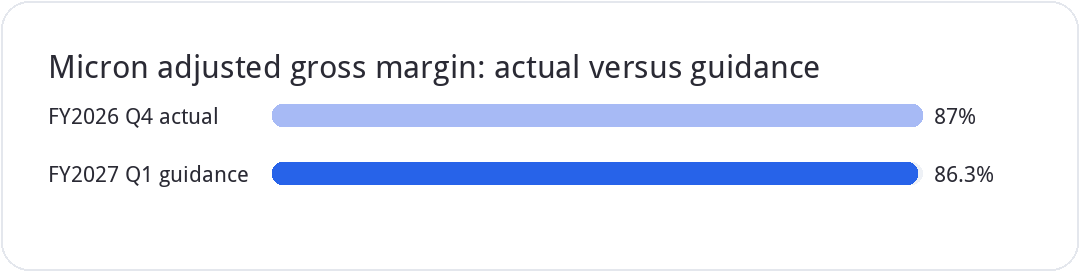
MU reported fiscal 2026 fourth-quarter revenue of $54.23 billion, adjusted EPS of $33.42, and an adjusted gross margin of 87%. For fiscal 2027's first quarter, it guided to revenue of $61.5 billion, plus or minus $1.5 billion, and adjusted EPS of $38.15. Revenue and earnings continue to rise.
The next quarter's margin outlook deserves closer attention. Gross-margin guidance of 86.3% is below the fourth quarter's 87%. The company attributed part of the change to incentive-compensation adjustments and expects the first quarter to be the low point for gross margins in the new fiscal year. That remains a management forecast, subject to confirmation in subsequent results.
Fourth-quarter operating cash flow of $44 billion and free cash flow of $33.2 billion support the quality of that quarter's earnings. The company also expects approximately $25 billion of capital spending in fiscal 2027. A single quarter's cash flow cannot be offset directly against a full year's investment, but both help assess cash returns as capacity expands.
The relatively restrained earnings reaction may reflect the high growth expectations already in the stock. A revenue beat alone does not establish that another rally is about to begin. Memory pricing can materially change forward earnings, and a low P/E may use profits close to a cyclical peak.
For MU, 1030 remains a near-term downside reference, with 1125 to 1211 the area to watch above. A break below 1030 would weaken the short-term setup. The 858 level marks a broader defensive threshold. These levels define conditional trading scenarios; they do not guarantee future prices.
SanDisk's downside distance deserves its own risk budget
SNDK benefits from memory demand, but its trading risk needs a separate assessment. The area from 1953 to 2091 is an upside reference. Below, a loss of 1704 would bring attention to support near 1650. The farther away support sits, the more clearly a trader needs to define an acceptable loss before entering.
Increasing position size to follow a sector rally while placing a stop far below the entry can compound portfolio risk. Even with improving fundamentals, an oversized position can make a pullback difficult to absorb. Entry price, stop distance, and position size need to be considered together.
Rotation and defensive stocks require different confirmation
GOOG and AMZN remain worth watching for rotation within technology. A longer-term valuation case needs support from earnings and cash flow. Near-term confirmation requires a sustained improvement in price. One positive session does not establish a broad shift in capital, and recent underperformance alone does not make a stock cheap.
TRV has a weaker technical setup. Whether a decline creates a longer-term opportunity depends on selling slowing and support forming. For investors with substantial existing exposure, waiting to add and managing current downside are separate decisions.
For LLY, the area from 1000 to 1080 remains the focus. Holding it would allow continued monitoring of the growth outlook. A break below 1000 would shift attention toward 928 and lower levels. Weakness may reflect changing expectations, but a price break alone cannot confirm that institutions have cut their fiscal 2028 growth forecasts.
Let confirmation determine fourth-quarter exposure
Over the next several sessions, the bullish conditions are cooler inflation, resilient employment, falling long-end yields, and semiconductors holding up while more sectors recover. Broader participation would confirm that setup. Rising yields accompanied by breaks in the leaders would invalidate it.
The neutral scenario has yields staying elevated, stronger stocks consolidating, and laggards still unable to take over. Keeping exposure flexible and respecting each position's downside threshold would fit that market. An index rebound without broader improvement is insufficient reason to raise risk across the portfolio.
The bearish scenario combines another rise in yields, further declines in weaker stocks, and memory names losing near-term support. That would pressure valuations and risk appetite together, making concentrated positions and stop-loss plans the first things to review.
After this week's payroll report, assess yields and market breadth over the following three to five sessions. A renewed rise in long-end yields argues for tighter technology exposure. More sectors holding support and joining the advance would justify a gradual increase in risk.