Tech bled. The tape did not break

US Stocks · Options · News · Views
Breadth was fine
Thursday the Nasdaq 100 fell 1.39% and the Nasdaq Composite fell 1.25%. Plenty of tech names were down three or four points, which looks like a break if that is all you see. It was not. Inside the S&P 500, 339 names rose and 163 fell. The equal-weight S&P rose 0.6%. Eight of eleven sectors rose. Of the three that fell, health care and utilities were down only a fraction of a point. Tech itself was down nearly 2 points.
The logic is the same as the day before. Third-quarter names that already had low growth expectations have an easier bar to beat. Thursday was tech paying back the groups that had been weak. It was not a broad break.
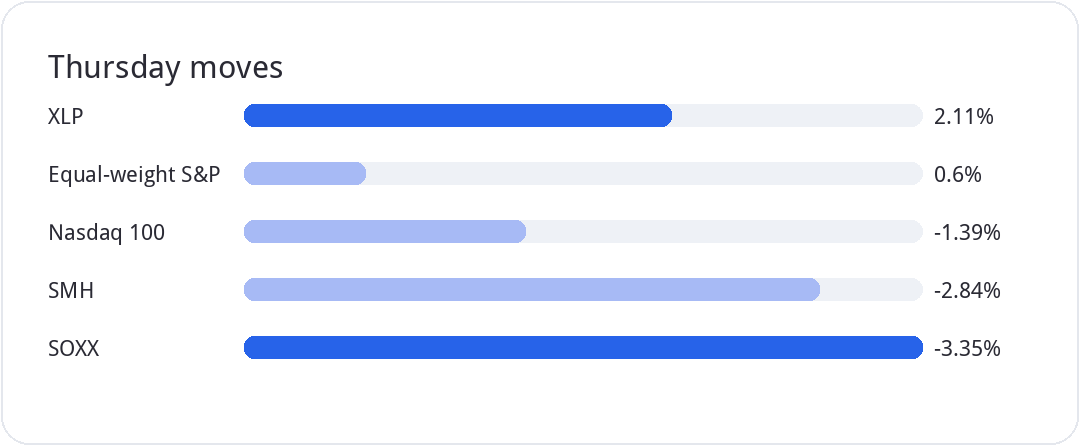
Read the advance-decline line before the Nasdaq candle. A 339 to 163 tape is not a market-wide selloff.
Waller still wants the option to hike
This year's voter, Waller, was hawkish. Further hikes may be needed to control inflation. The Fed can be flexible and does not have to hike at every meeting, but inflation is still too high. Strong artificial-intelligence investment and an energy shock that has not gone away are both adding to prices.
Initial jobless claims were 197,000, below the 200,000 expected. Continuing claims were 1.716 million, a bit high, and still low in absolute terms. Claims are not jumping. The focus stays on inflation.
That print does not explain Thursday's split. The split is money leaving tech.
XLP closed at 83.4. 84.8 is the turn
Consumer names were up broadly, one, two, and three points. XLP was a high-volume candle, up 2.11%. There are too many stocks to call one by one. The index is enough: the big weights have to rise for the index to rise.
The nearest strong supply at 83.6 is still overhead. The close was 83.4. Treat it as a bounce, and a strong one. If it can stop falling, chop near the highs, and get earnings beats, it can reach the level that would end this decline. That level is 84.8, about 1.3 to 1.4 dollars away.
Through 84.8, this consumer decline can be treated as a bottoming attempt. A lot of these names are already deeply down. Earnings still have to not be a mess. Money showed up for two reasons. Weak names had low bars, so beats are easier. Semiconductors had their own bad news.
If the book is consumer staples, watch whether XLP clears 84.8. Short of that, it is a strong bounce. Through it, the group's recent low is likely in. A single name with a broken quarter is a separate case.
Samsung's miss is real. The OpenAI gap was an accounting note
SOXX fell 3.35%. SMH fell 2.84%. Two headlines. Samsung's third-quarter operating profit and revenue both missed, and memory was weak before the open. That one is real, and it lands on memory.
During the session, artificial-intelligence names were offered together. The Financial Times said OpenAI's annual revenue was 20 billion dollars below the prior figure, 50 billion instead of 70 billion. That cooled the demand story. CNBC later said the gap is an accounting method. Semiconductors got some of the loss back after that. Thursday's group was mostly those two headlines pushing it around.
Price the memory group off Samsung. Do not price the demand story as if revenue had been cut in half. An accounting gap and an earnings miss are different.
The SOX divergence is repaired. 550 is still intact
SOXX broke its downtrend and cleared 577, so the structure still points at a new high. It will not go there in a straight line. The September 22 daily bar was the first high of a bearish divergence, and the two October highs had lower RSI readings. The divergence had not been repaired. Thursday pushed, then pulled back, and the divergence was repaired.
The retest reached 567, still on the 550 to 577 support from the breakout. Nothing broke. A break of 550 does not enlarge the risk. The structure still looks toward a new high. The chop just extends down to 486, a 486 to 577 range. Only a break of 486 changes the view. That is roughly 15% to 20% away. It is early to trade that level.
The fundamental cracks are real enough to watch: credit, financing, revenue that does not cover spending, and whether a mega-cap third-quarter report releases a slower 2027 capital-spending path early. They have not broken yet. Trade the structure until they do.
SMH is the same story. It is back in 586 to 613. It weakens under 557. It has not broken. After a high-volume down day, a fast reclaim needs real good news. Otherwise it chops and waits for third-quarter reports.
This SOXX pullback is an entry, not an exit. Do not call a trend change while 550 holds. For SMH, the line is 557.
The big down moves are still inside the structure
AMD fell 3.9% to about 620, the first small support. The zone above it is thin because the rise was fast, so a pullback is where the shares change hands. Real support starts at 562. The first band is 605 to 626. Through 605, the path down to 562 is fast, about 40 dollars.
NVDA medium support is 219 to 232, and the price just got there. A normal pullback, no break. After the new high, the structure is still up.
AVGO is a long-term zone at 324 to 365 if growth is not cut. Sell-side numbers lag, so the test is whether 324 breaks. A break means institutions are not defending it. A trade there needs the stop under a break of 324. If capital spending holds, the operating story is intact. The financing guarantees, about 50 billion in the discussion, pressure credit and the debt rating. That is a balance-sheet cost. NVDA has more cash.
TSM put out revenue figures. No need to unpack them today. It came down with the group. The first retrace is under 460, at 443. Aggressive interest is under 438. The longer-term level is 408. Both are close.
MSFT moved a little more than a point. Normal. The upside reference is still above 600.
AMD should not lose 605. NVDA at 219 to 232 is not a break. AVGO can be held from 324 to 365, and 324 is the exit. A TSM dip under 438, or toward 408, is an add, not a knife.
SPY can be an aggressive buy. QQQ should not be chased
SPY near 759 and 776 is already an aggressive long-term entry. It rests on the 2027 S&P forward range: a ceiling around 8500, a middle band around 7000, 7500, 7600, and 7700. The market is pricing 2027 six to twelve months early. A better excess-return entry is under 753. Anyone who only wants roughly 7% to 9% a year does not need to trade these levels.
QQQ is harder. A long-term add is 700 to 728. Spot at 737 to 746 is too aggressive. Active money is not adding there, so the push is missing. The S&P can rise on stocks that are not tech. QQQ can still fall in that tape. It has split from the S&P. It trades tech and semiconductors. Under 700, do not catch the knife. The next place is under 664.
XLK is not the same basket as QQQ. The levels that matter are 182 and 188, and 171 to 177. The trade, if any, is inside 171 to 188. October is volatile enough for that range to be crossed in a day or two, sometimes inside one session.
Thursday's volume was heavy, and some options settlement was pulled forward. Friday's volume may be lighter.
SPY at 759 and 776 is an aggressive lot, not a price everyone needs. QQQ is a poor entry here. If 700 breaks, leave it. Do not paste QQQ levels onto XLK. Use 171 to 188.