Why Marvell Values Lumentum at $115 Billion

US Stocks · Options · News · Views
Owning the Lasers Still Leaves the Engineering to Do
On November 2, Marvell and Lumentum announced an all-stock acquisition agreement in a joint statement. Lumentum shareholders would receive 4.5 Marvell shares for each share they own. Based on October 28 share prices, the deal implies an enterprise value of about $115 billion. The companies expect to close in the first half of 2028, subject to shareholder and regulatory approval. Reuters reported the terms the same day.
That $115 billion is neither cash Marvell has already paid nor a budget for new factories. The exchange ratio is fixed; the deal's value will move with the share price. For customers building AI clusters, the more useful question is whether combining these businesses can shorten delivery times for optical connectivity products.
Moving data between GPUs requires far more than compute chips. Marvell brings electrical-signal DSPs, switching chips, and custom silicon. Lumentum supplies indium phosphide lasers, optical transceivers, and optical circuit switches. Bringing those capabilities under one roof could let engineers coordinate chip, optical-component, and packaging designs earlier, reducing interface changes and supply-chain friction.
On November 3, industry researcher TrendForce also identified indium phosphide lasers as a key piece of the transaction. Co-packaged optics places optical components closer to chips to improve power efficiency and bandwidth density in high-speed connections. Laser yields, cooling, packaging, and customer qualification still need engineering work. Changing ownership does not resolve those constraints.
Management expects more than $1 billion in annual run-rate cost synergies after integration. That remains a target. The announcement provides no reproducible cluster tests showing that customers' total cost per million tokens has already fallen. Better coordination could help customers get products sooner and reduce their bills, but orders and deliveries will have to establish that.
For MRVL and LITE investors, deal progress and operating performance deserve separate attention. Shareholder and regulatory approvals shape expectations for integration. Near-term results depend on the companies' own laser supply, product qualification, and customer adoption. A deal expected to close in 2028 cannot be counted as additional capacity in 2027.
The $1,280 Research Figure Covers Only Part of the Cost
On November 4, OpenAI published a Linux kernel security study conducted in mid-October. It reported 948 distinct local privilege-escalation vulnerabilities validated through exploitation, along with candidate patches, using about $1.2134 million in API credits. GPT-6 Cyber, the model used in the study, was released on November 5, initially to some approved customers in the Daybreak Red program. Reuters, iTnews, and other outlets covered the research and access restrictions. Their reporting does not independently reproduce all the findings.
About $1,280 is the API-credit allocation per distinct vulnerability in that account: $1,213,430 divided by 948. The study makes the model's API consumption visible. A business's full cost of fixing a vulnerability requires a separate calculation.
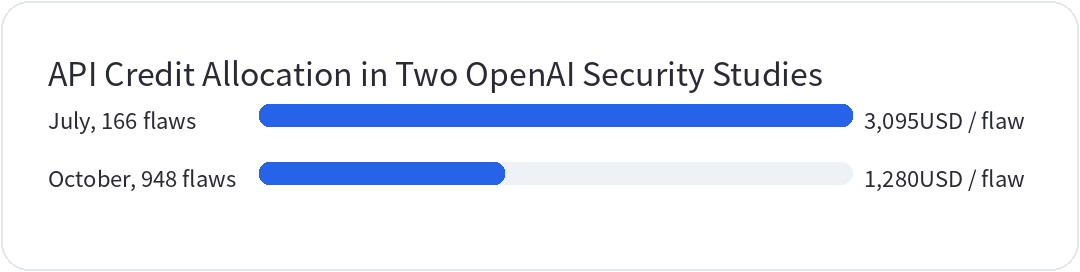
Company-reported dollar-denominated API credits are divided by distinct vulnerabilities validated through exploitation, then rounded. The kernels, targets, and workflows differed, so this is not a controlled performance comparison. Full human review, operating environment, and fix-delivery costs are excluded.
The July study used about $513,700 in API credits and reported 166 distinct vulnerabilities validated through exploitation, allocating roughly $3,095 to each. These figures show how the research accounts changed. They do not establish an efficiency gain on identical tasks: the kernel versions, targets, and workflows changed, and the denominator was not a fixed set of equally difficult tests.
Human review and remediation still cost money. Security teams must confirm reproducibility, check for duplicates, and test whether candidate patches break other functions. Maintainers then need to review, merge, and release fixes. Businesses must deploy them on running systems. A working exploit, a proposed patch, an accepted patch, and a deployed fix represent different stages of completion.
Security budgets should follow that work through to completion. More discoveries without faster remediation could increase both backlogs and review hours. Buyers should track the same set of findings from submission to merge and deployment, including human work per delivered fix. Comparing about $1,280 directly with the full cost of human-led remediation would leave unfinished work out of the calculation.
Cursor Makes Launching Easier While Operations Remain
On November 5, Cursor introduced Build Live Apps in Cursor in an official update. Paying users with cloud-agent access can have an agent generate a web app, provision Postgres as needed, integrate Cursor single sign-on, and handle hosting and deployment. The New Stack covered the feature and its hosting arrangements on November 6. An app goes live only when the user explicitly initiates publishing and the checks pass.
Database setup, authentication, and deployment used to stand between generated code and an application other people could use. Cursor brings those steps into one workflow, shortening the path from a request to an accessible app. The New Stack quoted Vercel as saying that it runs on Vercel for Platforms, removing the need for users to connect a separate Vercel account for this step.
Internal-tool teams may feel the difference first. A query page or approval interface that once required infrastructure coordination can reach a trial version sooner. The platform's relationship with its customer may also extend from writing code to operating the application. A successfully published URL, though, does not establish that total engineering costs have fallen.
Once an app touches business data, someone must define who can sign in, who can read or write, and who issues credentials. Backups, failures, rollbacks, and data migration follow launch. Cursor's automated checks and administrator controls can reduce some manual configuration. Businesses still need to assess those capabilities against their own data and operational risks before judging whether they meet production security requirements.
Costs need to cover the application's operating life. Alongside model calls, the calculation includes hosting, databases, traffic, human review, and maintenance. The release and supporting documentation do not provide a dedicated price schedule sufficient to calculate a complete per-app operating bill. Subscription fees or code-generation tokens alone can miss expenses that arrive after launch.
A useful test comes 90 days later. How many people still use the app, and how much maintenance does each actively used app require? Those answers matter more than the number generated on launch day. If rework and operations grow alongside deployment counts, faster generation may not translate into cheaper delivery.
Measure Delivery and Costs over the Next 2 to 3 Quarters
Hardware supply chains, security research, and app development all advanced this week. The next test is whether changes in spending and output counts give customers better products that pass acceptance checks and remain useful.
Through Q2 and Q3 2027, optical connectivity should be judged on customer qualification, conversion to orders, and delivery progress. Marvell and Lumentum will still be ahead of their expected closing date. Each company's own supply capability explains current revenue better than integration promises. More design wins without better deliveries would make it hard to treat the transaction's implied enterprise value as evidence of near-term incremental earnings.
Security tools need to track the same set of findings over time. Reproducibility, maintainer acceptance, time to released fixes, and human review hours belong in the same assessment. Moving budgets toward automation becomes supportable when definitions remain consistent, quality holds, and the full cost per delivered fix falls.
App platforms need usage and expense records. The share still active after 90 days, total cost per accepted application, maintenance hours, and rollbacks can test whether easier publishing improves business operations. Generation and launch counts alone do not give companies enough evidence to move more critical processes onto a platform.
Hardware companies are seeking more complete supply chains. Model companies are publishing unit-level API research accounts. Development platforms are shortening the path from a request to a live app. These advances have value. Investors and buyers still need to establish how much better the customer's result becomes, and who carries the remaining work and expense.