JPMorgan Turns Tactically Bullish While the Ten-Year Stays at 5.26%

US Stocks · Options · News · Views
Utilities led, and the long end is still rising
Tuesday was not a broad rally. The Dow closed at 51,349.92, down 0.26%. The S&P 500 closed at 7,670.84, down 0.17%. The Nasdaq Composite closed at 26,797.54, down 0.09%. The Nasdaq 100 was the one that actually rose, up 0.21%. Four of the S&P 500's 11 sectors finished higher and seven finished lower. Utilities led on rising volume, up about 1.1%.
Read that gain on its own. Utilities were the squeeze candidate yesterday, and flow showed up today. The height of the bounce is not something to forecast, and it is not a fundamental turn. If you participate, treat it as a short-term flow and take the gain.
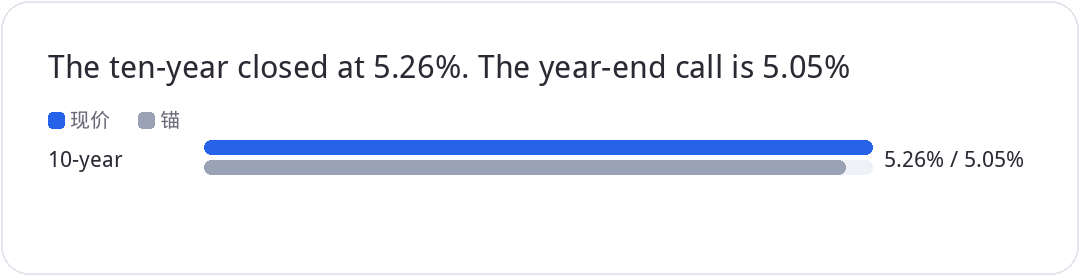
New York Fed President Williams was dovish: after the September hike, there is no need to rush the next one. Front-end yields fell, and the October hike odds dropped from about 70% to roughly a coin flip. The long end did not follow. The 10-year touched about 5.29% and closed at 5.26%, still the highest close since 2007. Lower oil limited the equity damage. It did not pull the long end down.
Confidence and job openings both missed
September consumer confidence fell from 88.6 to 81.9. The consensus was 89.2. That is the lowest reading since April 2014. The present-situation index dropped 7.9 points to 109.3. The expectations index dropped 5.9 points to 63.6. The share calling business conditions bad rose from 17.3% in August to 20.4%. The share saying jobs are hard to get rose from 20.3% to 21.9%. In the written answers, mentions of prices, the high cost of goods and services, and oil and gas prices hit a new high.
August job openings fell from 7.335 million to 7.079 million, below a forecast near 7.23 million. The openings rate slipped from 4.4% to 4.3%. Quits eased from 3.089 million to 3.066 million, and the quits rate stayed at 1.9%. Total separations fell from 5.128 million to 5.07 million, and that rate stayed at 3.2%. Layoffs fell from 1.702 million to 1.641 million, and the layoff rate fell from 1.1% to 1.0%. Demand is cooling. Layoffs have not blown out.
PCE, payrolls, the ISM manufacturing index, and Micron's earnings are still ahead this week. Those prints decide whether 5.26% pauses or keeps climbing.
The tactical upgrade is a view, and the caveats stay attached
JPMorgan's institutional market-intelligence desk has been accurate on the big S&P turns for the past two years. On August 31 they shifted to tactically neutral. The S&P bounced a little and then weakened, and it is now back near the late-August level. This time they moved to an explicit tactical long. The window is the one or two months from third-quarter earnings through year-end. It is not a long-term bull case.
On the macro side, they say the flash PMI is stronger than the growth already in the price, which should support hiring, spending, and corporate earnings. S&P earnings per share track nominal growth, not real growth, and the current economy makes sell-side earnings estimates look too low.
On the consumer, they still see spending beating expectations. They do not accept that a K-shaped split has already broken demand, and they say the labor market is improving. That does not line up with today's confidence survey. Confidence is at a twelve-year low, and openings missed. Strong consumption is their view. It is not a settled fact.
On earnings, after 52% year-over-year S&P EPS growth in the second quarter of 2026, the market expects about 29% growth in the third quarter. They think that is low, because all 11 sectors are expected to post positive revenue and positive earnings per share. The implication is a broad set of beats.
On rates, they expect firmer growth and inflation data that are flat to dovish. The 10-year holds near current levels and finishes the year around 5.05%. A lower yield would cut bond volatility and take some downside pressure off equities.
On positioning, seasonality is improving, retail may come back, and the book is light.
The long problems are still on the page. Is the bond market underpricing this hiking cycle? If the flash PMI is consistent with about 5% real growth and inflation pressure is still rising, a labor market that keeps hiring can force a stronger cycle than what is priced. As of yesterday, money markets still had three hikes over the next 12 months, with a small chance of a fourth. Does the market start pricing 50 basis points at each meeting? When does food inflation reach the core? Can industries outside technology earn a decent return?
The playbook is specific. Technology stays the core long. A drop in oil and a slide in Treasury yields still create squeeze risk, the same line as yesterday. So they stop pairing a technology long with a Russell short. The Russell is the most sensitive to the 10-year. If the call is for a lower yield, that short does not belong. If the squeeze comes, it will be fast, and they want options rather than a cash short. Semiconductors and the big seven may broaden and beat the technology sector itself. Software is warming slowly and is still not a mainstream bullish bet. They still like the AI theme.
Outside technology, cyclicals need a steeper yield curve before the move can last. Within that group they prefer banks: growth restarting, a curve that may steepen, a better capital-markets backdrop, and a group that has already pulled back. Cyclicals are not untradable. They are not already launched.
A view is a view. The August neutral call was followed by a weak tape. That does not mean this bullish call will be. Two sessions remain in September, and the S&P is still down about 0.2% for the month. In a midterm year, September and October are about volatility, not a straight line. The seasonal improvement usually shows up in November, after the election.
Systematic money does not sell unless the drop is large
Goldman-tracked systematic trend funds sold about $15 billion of global equities over the past week and about $70 billion over the past month. The global equity long is down to about $72 billion, the 54th percentile, a middle-of-the-road book. In a flat or rising market they have no reason to sell more. A real sale needs a real drop. Roughly, the S&P has to fall through 7,500, toward 7,300 to 7,400, before that trigger is live again. The level has already shifted once after it was hit, and it has not been refreshed into a precise line. Treat it as a zone, not a button.
If price holds, this money does not come in to sell in the near term. What is actually pushing the market is third-quarter earnings, and the 10-year. It closed at 5.26%. A move to 5.5% would be a large, negative equity reaction. A move down toward 5% would be a large, positive one. For this stretch, the 10-year is the main contradiction.
Meta's stabilization arrived too fast
META was a stall after Friday's top, and Monday completed the daily repair with one drop. Tuesday printed the stabilization, and buyers came in fast. The round trip was about four to six points. A slow hand either sold the low or bought the high.
After the repair, the larger direction is still constructive. Defense is 690 to 730. Overhead is a break of the prior high. If you are still in it, this stretch can be held a bit longer. The view changes if Monday's low breaks. The technical repair can be done while the pullback is not.
ASML and Lam: the break is close, and the valuation is not cheap
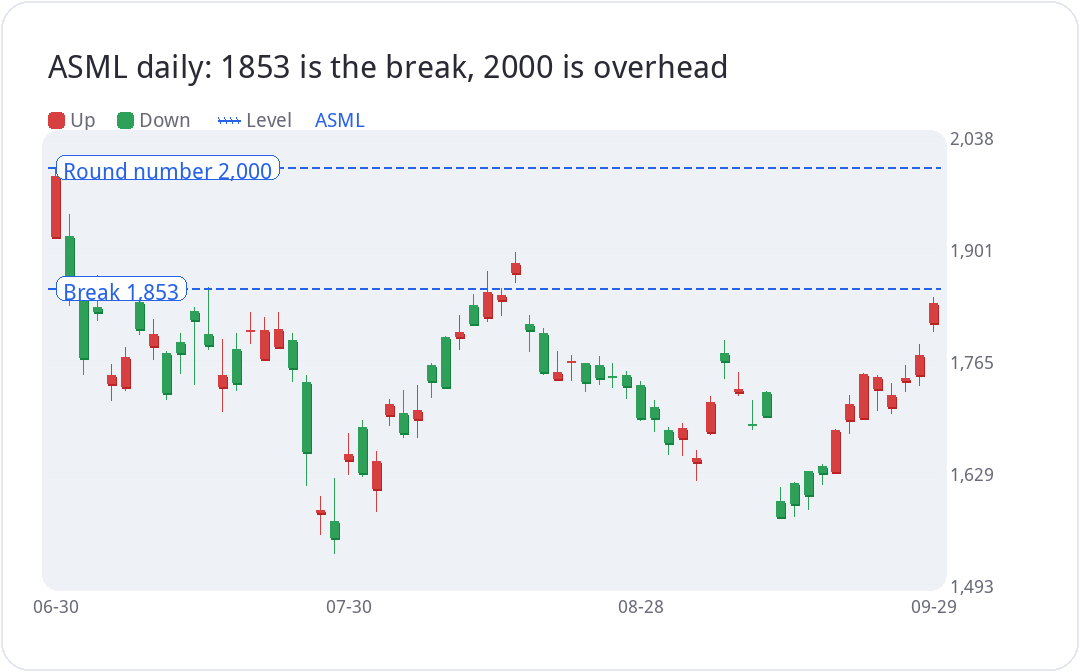
ASML has two straight days of stepped-up volume, and 1,853 is nearly through. A clear of that level points the chart at new highs, with 2,000 above. The forward ceiling is 2,257, about 45.7 times forward earnings. The chart can be a breakout. Another leg higher is expensive on the fundamentals. This is still the steady equipment name. What changed is the level, not the story.
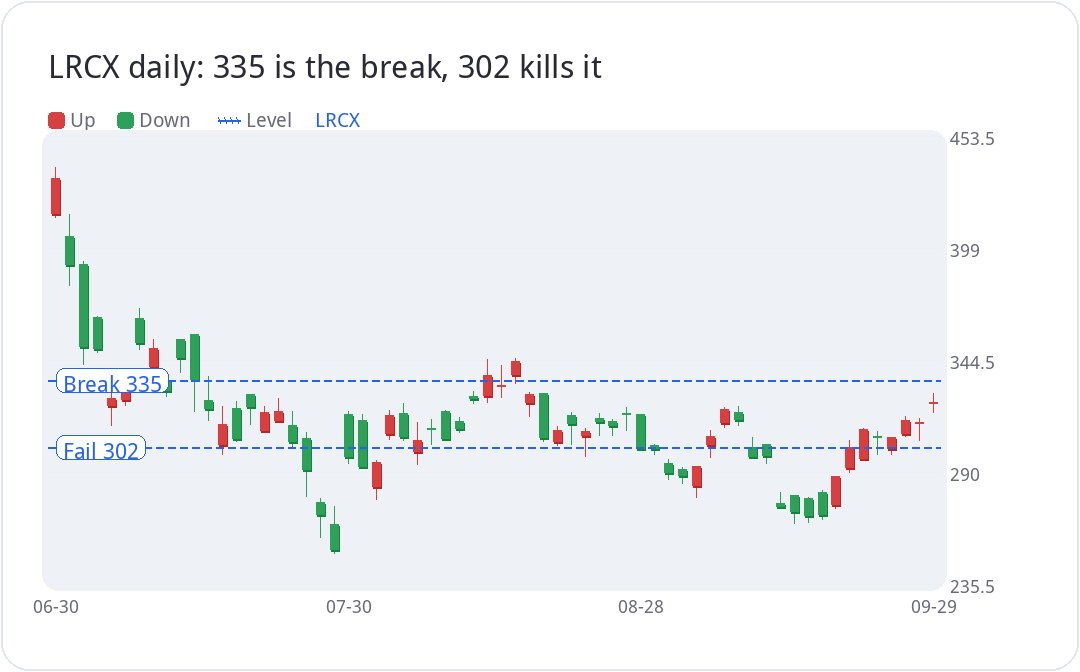
LRCX is still well below the prior high. A move through 335 is what starts the higher-low, higher-high structure, a slow stair-step rather than a three-day sprint through roughly 35 points. Until it clears, the break has not happened. A loss of 302 ends this push and puts the stock back in a range.
The fundamentals are not cheap. The June 2028 forward figure is about 287. Growth is faster than its own history, and even a stretch to 35 times is still not cheap. A straight run to 400 is expensive. The swing can follow the structure. Do not treat a technical break as confirmed earnings before the third-quarter report.
Oracle needs 170 before the decline is done
ORCL rose about 4% on rising volume. The catalyst was a report that OpenAI's annual recurring revenue is approaching $70 billion, above the earlier line of an annualized run rate over $40 billion by the middle of 2026. A separate report on Anthropic's documents described spending and losses that do not line up. Both are secondhand reads on private companies, and the angles differ. The tape used the OpenAI revenue headline to buy Oracle.
The level matters more than the headline. A break of 170 is what confirms the decline has stopped. From 137 to 170 is one wide supply zone, and the market price is still far from 170. Above 170, it can base. Below it, the stock is still inside supply. OpenAI is changing too fast to underwrite a six-month or one-year hold from here. If you can sit through it, that is your call. If you cannot, do not use time to bet on a stabilization that has not confirmed.
Three paths
Bullish: the 10-year works toward 5.05% or 5%, oil stops feeding the inflation scare, and both utilities and growth benefit because the discount rate came down. Semiconductors and the big weights beat the technology sector, and the Russell is no longer the rates short. That is a tactical window through third-quarter earnings and year-end, not proof of a new long bull market.
Neutral: the 10-year grinds around 5.26%, and systematic money does not sell a flat tape. META holds 690 to 730. ASML and LRCX neither break nor fail. The bullish call stays on the page, and price does not confirm it.
Bearish: the 10-year moves toward 5.5%, and the S&P falls through 7,500. Systematic money sells again. Banks and cyclicals can be the preferred fundamental group and still get pinned by the curve. If ORCL cannot clear 170, the revenue headline was a bounce.