Nasdaq and Semiconductors Break Support as AI Credit Diverges

US Stocks · Options · News · Views
After the breakdowns, slow the pace of buying
Friday's selloff calls for a slower pace of buying. On October 30, QQQ closed at $690.49, down 3.47%, while SOXX finished at $471.51, down 8.24%. Both lost the previously watched support levels: $696 for QQQ and $486 for SOXX. Semiconductors fell harder, weakening the case for chip stocks to lead a technology rebound. Any bounce next week needs to be judged by whether those lost levels can be recovered.
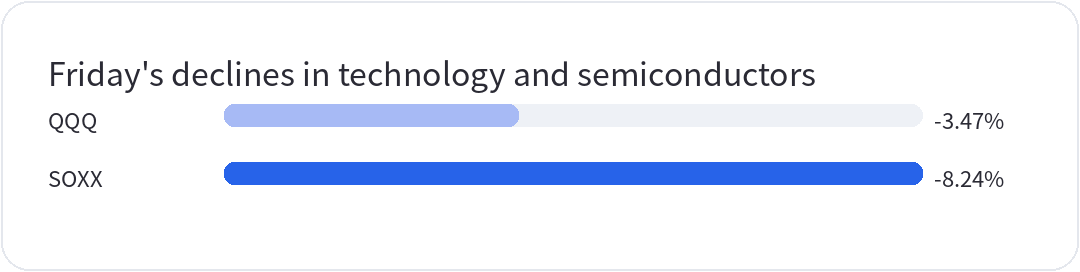
Defensives held up better. Consumer staples ETF XLP rose 1.41%, in contrast to technology. That is consistent with weaker risk appetite and a preference for defensives. A few ETFs, however, cannot establish a market-wide liquidity crisis. Underestimating the decline can encourage more buying, while treating it as a full collapse can lead to selling everything during a sharp decline.
Fed officials Logan and Musalem continued to argue for further monetary tightening on Friday. Technology stocks must contend with funding costs and discount rates alongside AI demand. First assess how much more downside existing positions can absorb. A large price decline does not remove the need to assess valuation before buying.
The AI buildout has to clear a funding test
The AI buildout requires spending before customer payments and investment returns typically arrive. Data centers, chips, power commitments, and leases all need funding. Whatever operating cash flow cannot cover must come from creditors or shareholders. Borrowing rates, collateral terms, and maturities all influence how long expansion can continue.
Microsoft MSFT can still secure large commitments of long-term debt capital. On October 29, the company priced a $25 billion bond offering across ten tranches, with maturities of roughly two to forty years. Settlement was expected on November 4. Bloomberg reported peak orders of about $115 billion, or 4.6 times the offering size. The order book measures demand; the offering itself remained $25 billion. The disclosed use of proceeds also covered several general corporate purposes, rather than committing all the funds to AI.
Credit pressure at CoreWeave CRWV drew attention in mid-October. Reuters reported on October 15 that the cost of five-year default protection had exceeded 1,000 basis points. Higher protection costs reflect credit-market concerns and could raise the hurdle for subsequent borrowing and refinancing. They do not mean a default has occurred.
The Financial Times reported on October 30 that Blackstone expected Anthropic might initially fail to obtain an investment-grade rating after going public. This was an expectation about a future rating. A below-investment-grade rating could affect the pool of buyers and financing costs. Distinguish IPO plans, financing commitments, and settled funds when assessing a funding gap.
Strong bond demand and an attractive stock are separate judgments. Creditors focus on receiving principal and interest as agreed. Shareholders also bear the risk of poor investment returns and lower valuations. Even a company that can borrow may see its shares pressured if capital expenditure keeps consuming operating cash flow and free cash flow fails to improve.
Compare debt maturities with the timing of customer payments. Expansion funded by existing operations carries a different risk from expansion dependent on the next financing round. If debt matures before customers pay, the funding gap needs to be addressed in advance. Higher required returns on new financing squeeze project profitability; they do not immediately reset the contractual interest on existing fixed-rate debt.
These credit differences can help screen companies, but they are not enough to explain Friday's entire technology selloff. The impact of a single credit headline cannot be isolated from the index decline.
Long-term conviction still needs valuation and position limits
Stocks tied to the same investment cycle are already delivering very different returns. From the September 30 close to the October 30 close, MSFT rose about 1.76%, NVDA fell about 10.39%, and TSM lost about 10.97%. These are price returns excluding dividends. Assess each company's valuation, capital intensity, and expectations already embedded in its price. Sector demand alone cannot determine the value of every stock.
If AI no longer appears likely to create adequate corporate returns, positioning should reflect that view. Use rebounds to trim related exposure and add cash or short-duration assets with strong credit quality. Continuing to look for reasons to buy the dip would put actions at odds with that judgment. A bearish view still needs a workable short setup: sharp rebounds and carrying costs can undermine the trade.
Investors who remain uncertain can wait and focus their review on companies with large funding gaps, weaker credit, and frequent refinancing needs. A lower share price may not compensate for funding risk. If the long-term view is unchanged, valuation and position size still come first. Cash generation and stronger credit can provide a better basis for buying in stages.
Before buying, ask how much future profit the current price requires and how much of that profit can become cash. If the return case works only with the most optimistic assumptions for utilization, margins, and financing, conviction should not be used to justify a larger position.
For existing holdings, revisit the original reason for buying. A multiyear cash-flow investment should be assessed through order conversion, customer concentration, free cash flow, and funding terms. A short-term trend trade should follow its price discipline when a predetermined level breaks. Both strategies can coexist. Relabeling a losing trend trade as a long-term investment abandons the original exit discipline.
Cash also has a purpose. Keeping funds available allows investors to act in stages when valuation improves or price action confirms a recovery. Assess the next trade's potential loss against the whole portfolio. Holdings with different tickers can still sell off together when they rely on the same AI spending cycle and funding tightens. A sharp decline does not require every decision to be made in one session.
QQQ approaches its 200-day average; SOXX needs to recover
QQQ's next reference is around $678.4, its 200-day moving average calculated using adjusted daily closes through October 30. The $690.49 close remained about 1.78% above that average. The Nasdaq ETF therefore had not broken its 200-day average. For a short-term recovery, watch whether a rebound can reclaim $696 and hold it over the following sessions.
If QQQ stabilizes near the 200-day average and gradually recovers $696, watch whether buying interest follows through. If it breaks decisively below the average and then fails to reclaim it, leave room for a deeper correction. $600 belongs only in an extreme downside scenario. It is not a confirmed target or a sound basis for a trade at this stage.
SOXX is weaker. On the same basis, its 200-day average was about $476.0, leaving the $471.51 close roughly 0.94% below it. Reclaiming that average, followed by a sustained recovery above $486, would strengthen the case for a recovery. If rebounds fail at those levels, semiconductors could keep weighing on technology.
These levels are decision points, not guarantees that price will stop there. Intraday breaks and brief recoveries can be misleading during a busy news cycle. Closing levels and follow-through over subsequent sessions carry more weight than a single touch.
November starts with elections, oil, and funding
The US midterm elections on November 3 will change expectations for the ability to advance policy. Watch how the results affect fiscal, tax, and industrial policy expectations, and whether Treasury yields and equities give consistent signals. Betting on index direction solely from the winning party can overlook how much of the result is already priced in.
Developments in the Middle East and Iran keep oil in focus. Brent remained above $110 a barrel on Friday, and the election result will not automatically remove supply risk. If escalation pushes oil and inflation expectations higher while long-end yields stay elevated, expensive growth stocks would face greater valuation pressure. If negotiations reduce the risk premium and ease rate pressure, the backdrop for technology can improve. Prices still need to confirm that improvement.
The third issue is access to funding. For AI-related bonds, loans, and IPOs, watch the required returns and investor protections as well as the amount raised. If only a small group of strong credits can obtain long-term capital while others face higher costs and shorter maturities, divergence within the supply chain could widen. Better funding terms and stronger operating cash receipts would provide a firmer basis for adding exposure.
In the next session, focus first on whether QQQ can reclaim $696 and SOXX can recover its 200-day average. If a bounce recovers only a small part of the decline and closes below lost support, keep position sizes controlled and wait for confirmation.