Terra's $1 Input Price Is Only the Start of the AI Cost Equation

US Stocks · Options · News · Views
Terra lowers token prices, with task costs still to be tested
On October 26, OpenAI's API changelog announced the release of GPT-6.1 Terra. Standard API pricing is $1 per million input tokens, $0.05 per million cached input tokens, and $5 per million output tokens. BleepingComputer reported the launch and pricing the same day. Enterprises now have a publicly available option with transparent pricing. Those rates describe the cost of calling a model. The cost of delivering an accepted piece of work requires a broader calculation.
Cheaper input can reduce the expense of repeatedly reading documents, spreadsheets, and interfaces. A multistep agent still incurs reasoning and output costs, while tools may generate additional charges. A failed attempt that requires reloading the context and repeating the work can offset part of the input savings. Buyers need to add up every call through completion, then include human review time, to compare the new approach with their existing workflow.
Long context is especially easy to misprice. The official model documentation says that when input exceeds 272,000 tokens, input and cached input for the entire request are billed at twice the standard rates, while output is billed at 1.5 times the standard rate. Cache writes have separate charges. The $0.05 price therefore does not cover all cache operations, and the $1 input rate does not apply to every long-document request. Putting all files into the context can change a bill that initially looked cheap.
Errors are harder to price. A formatting mistake while organizing information might take seconds to fix. In finance or procurement, someone has to detect, explain, and correct the error. Pilots need a fixed task sample and consistent acceptance criteria, with failed attempts included in the bill. That lets buyers measure success without assuming a rate in advance. Terra's pricing makes broader trials more affordable. Turning trials into recurring paid use still depends on whether total cost per accepted task falls. Its public prices alone also cannot establish OpenAI's inference margin.
Fusion routes models to cut costs; acceptance needs its own accounting
On October 28, GitHub officially made Copilot Fusion generally available. It routes tasks across underlying models and coordinates their work. Users can select Standard, High, or Max, and administrators can restrict available models. Fusion can use a single model, escalate a difficult task, or have one model draft and another review. Each actual call is still billed at the underlying model's own standard price.
Independent evaluator Artificial Analysis tested Fusion Max in Copilot CLI the same day, comparing it with Claude Code running Claude Opus 5.5 Max. Its Coding Agent Index v2.0 weights three component tests equally. Fusion's average model API cost was $5.59 per benchmark task, against $11.42 for the comparison configuration. These are different coding-agent systems. Their performance and costs reflect the full configurations, rather than a single underlying model.
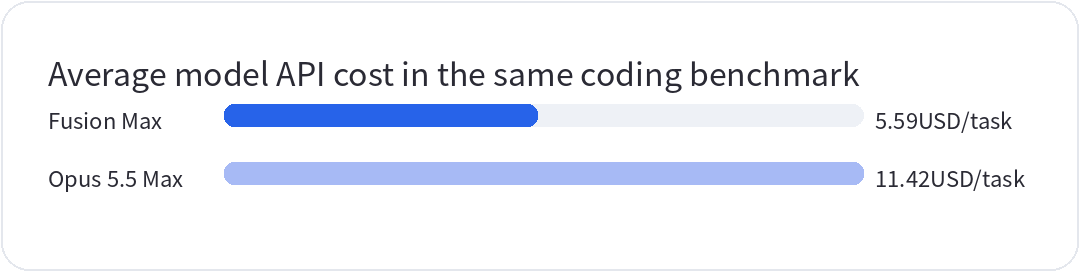
Roughly halving API expense is a result worth testing further. The denominator matters: this is average model API cost per benchmark task. It does not establish cost per successful task or a uniform saving on every task. Subscriptions and human review are excluded. GitHub also offers paid-plan users a temporary 30% discount on model charges through November 30. That promotion cannot be applied again to the chart's figures to claim a lower long-term cost.
Routing economics depend on judging task difficulty correctly. Using expensive models less often for simple steps can save money. Misrouting, extra reviews, and repeated escalation can add those costs back. For GitHub parent Microsoft (MSFT), the more useful question is whether developers keep trusting the system to choose models for them. Enterprise buyers need to compare acceptance rates, rework, review hours, rollback rates, and tail latency within the same codebase. A smaller API bill may deliver little project benefit if rework increases.
Helios enters testing at Meta; scaled delivery remains unproven
On October 27, AMD disclosed that the initial Helios systems had been installed at Meta and were being tested. TechTarget reported that disclosure on October 29 and noted that a date for broader deployment had not been disclosed. AMD and Meta (META) have reached testing with real systems. This disclosure does not establish that production service at scale has begun.
After racks are installed, the customer still has to run its business workloads on them. Networking and cooling affect stability, while power and facilities need to be ready. Software needs adaptation, and the systems must recover from failures. Industry analysts interviewed by TechTarget emphasized these delivery requirements. A single chip's advertised capabilities cannot establish how much usable compute a group of racks can supply for the customer's workloads.
A second supplier's value has to account for migration and ongoing maintenance costs. If every model or software update needs extensive custom tuning, engineering hours can consume the procurement savings. Adaptation work that can be reused makes a new platform easier to fund through regular budgets. Neither AMD's announcement nor TechTarget's report provided comparable Helios task-cost or energy-use data. They therefore do not establish that AMD delivers cheaper training or inference.
For AMD, moving from testing to deliveries the customer accepts would help convert partnership expectations into business. For Meta, another hardware option that runs reliably could improve its bargaining position when buying capacity and expanding. Their interests overlap, but installation and testing are an intermediate step. Over the next two to four quarters, watch for disclosed production workloads and service milestones, then compare progress with delivery-related revenue. Check actual utilization too, if comparable disclosures become available. A lack of public detail leaves the outcome uncertain; it does not establish that testing has failed.
Over the next two to four quarters, measure accepted work
Over the next two to four quarters, enterprises have more reason to judge AI spending by the accepted work it delivers. Terra lowers some model-call rates. Fusion tries to reduce expensive-model usage. Helios adds a hardware option. Each addresses one part of the cost chain. These developments have yet to establish lower costs for the finished results business users receive.
For software, the clearest test is savings on the same real tasks at the same quality threshold. Count API and tool charges across retries, then add human review costs. If Terra frequently needs escalation to pricier models, or Fusion requires more rework after the promotion ends, the case for low prices driving recurring paid use weakens. Stable acceptance rates, less human intervention, and savings that persist after promotions would strengthen the economic case for routing and model substitution.
For hardware, watch when test systems begin handling stable production workloads and whether deliveries generate revenue. Customers can gain procurement options while remaining constrained by software adaptation and facility readiness. Evidence of sustained operation and expansion would support greater confidence in revenue from alternative platforms. One installation announcement is insufficient grounds to recognize the full potential partnership scale in near-term earnings expectations.
This changes the order in which AI companies should be assessed. First ask how much work meets the customer's standards for the same budget. Then ask why the supplier can retain that spending. Low token prices make experiments cheaper. Profits still depend on repeatable delivery. In the next round of competition, will customers pay for cheap calls, or for results that require less rework?