Morgan Stanley Sees 8,000 for S&P 500, but Semis Must Clear Three Reckonings First

US Stocks · Options · News · Views
Solid Macro Prints Mask Thin Market Breadth
Across the macro tape, durable goods orders, new home sales, home prices, and particularly consumer confidence all beat consensus estimates, pushing the US Economic Surprise Index to its highest level in seven months. Easing crude oil prices cooled upstream inflation expectations, while hyperscale data center credit default swap spreads narrowed sharply to one-week lows. Driven by recovering risk appetite, the Nasdaq and semiconductor complex rallied for a second consecutive session, reclaiming all of last week's losses. For traders who trimmed or stopped out near prior breakdown levels, the two-day surge feels painful, but the medium-term direction remains far from resolved.
Underneath the headline index rebound, market breadth remains exceptionally weak. The S&P 500 closed with five sectors higher and six lower across its eleven major groups. Capital remained concentrated in mega-cap artificial intelligence bellwethers, with AI-exposed names gaining an average of 5% while the broader non-AI universe retreated 30 basis points. Goldman Sachs data shows global fundamental long/short gross and net leverage lingering near multi-month lows and drifting downward, failing to track the index rebound. The market move reflects tactical short-covering into major technical support rather than high-conviction institutional accumulation. In an environment dominated by short-horizon flows, headline advances remain vulnerable to sharp whipsaws and false breakouts.
Boeing Plunges on Slashed Guidance and Deep Loss
Beneath the surface of resilient benchmark indices, single-stock dispersion and operational headwinds are triggering sharp repricings. Boeing (BA) reported third-quarter results that beat lowered expectations on revenue and operating cash flow, but forward guidance sparked an immediate selloff. The company posted a core loss of $0.34 per share, significantly wider than the consensus estimate of a $0.21 loss, alongside revenue of $24 billion, up 4% year over year. Management acknowledged that reaching a sustainable production cadence will take longer than planned, forcing a material reduction in commercial jet delivery targets. Boeing now expects to miss its full-year target of 500 737 deliveries, while 787 Dreamliner deliveries will sit at the bottom of the guidance range at 90 units.
The delivery cuts impair medium-term free cash flow visibility and trigger broader multiple compression across aerospace suppliers. Boeing gapped lower at the open and dropped 10% intraday, carving heavy bearish candles across daily and weekly charts and firmly breaking below its 200-day moving average. Price is currently testing major support between $164 and $178, a volume shelf established during the April consolidation. A decisive breach of this floor opens the door toward secondary support at $149 to $159. With consensus earnings estimates for 2026 and 2027 facing downward revisions, attempting to catch falling knives before guidance stabilizes carries elevated risk. Similar earnings volatility surfaced in after-hours semiconductor earnings, where guidance misses triggered a 7% drop before bids emerged around key support at $215 to $233.
Morgan Stanley Flags 7,100 Tactical Target Ahead of Year-End Rebound
In a detailed research note, Morgan Stanley Chief US Equity Strategist Michael Wilson outlined the severe internal damage across broad equities. Within the Russell 3000, roughly 60% of component stocks have fallen more than 20% from their June 1 highs—the turning point when corporate earnings revisions peaked. More than a third of the index has dropped over 30%, and one in eight stocks has been cut in half. Damage across tech subsectors is even more severe: 96% of semiconductor names have tumbled more than 20%, 87% are down over 30%, and 42% have been halved. In software, 77% of stocks are down over 20%, while 72% of hardware names have suffered equivalent declines.
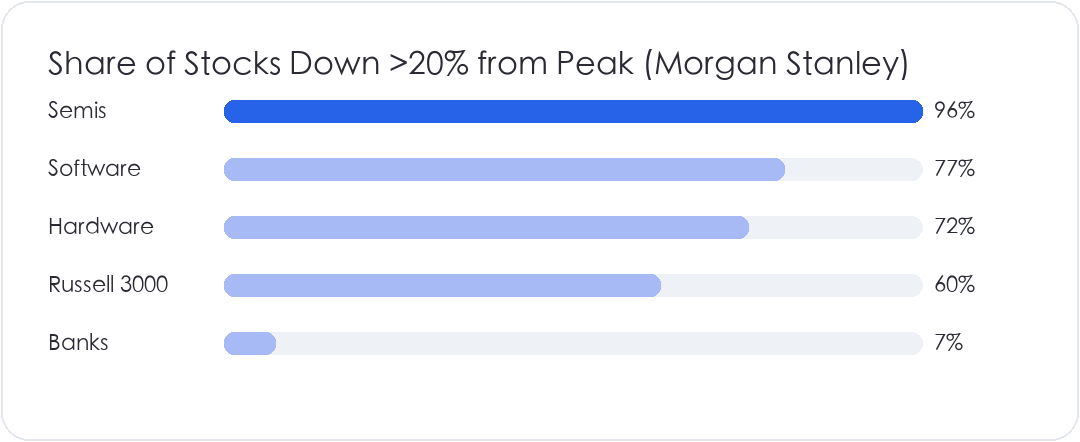
These statistics confirm that the major indices have been buoyed almost entirely by a handful of mega-caps while the average stock has already endured a standard bear market. Wilson frames this backdrop with a clear dichotomy of good news and bad news. The good news is that the cyclical correction that began in June is entering its late innings, with seasonal historical data showing October 27 frequently marking an inflection low in election-year volatility cycles. The bad news is that the market must navigate three distinct reckoning events before a durable bottom can form. Transitions of this nature typically conclude when headline indices catch down to match depressed breadth.
Morgan Stanley sets a tactical downside target of 7,100 to 7,200 for the S&P 500, requiring a modest breach of the 200-day moving average to flush late sellers and synchronize index levels with underlying participation. Because balance sheet quality factors remain resilient, Wilson views this tactical shakeout as the final down-leg before an aggressive year-end rally. The firm maintains its year-end base-case target of 8,000 for the S&P 500 and projects 8,300 on a 12-month horizon, setting up a sharp contrast between near-term turbulence and year-end upside.
Option Pricing Frames Tech Earnings Showdown
The battle between bulls and bears is nearing an inflection point as the options market prices elevated volatility into the weekend. The iShares Semiconductor ETF (SOXX) has rebounded off its 200-day moving average to form a three-day base, but the options tape reflects deep two-way uncertainty. At-the-money straddles expiring this Friday, October 30, price a $28 expected move on a $511 reference price, implying a ±5.5% swing over just three trading sessions. A breakout above $538 would clear horizontal resistance at $536 and confirm a trend reversal. Conversely, a drop below $483 would erase the entire two-day rally, taking the ETF back below its gap-up pivot into a broader technical breakdown.
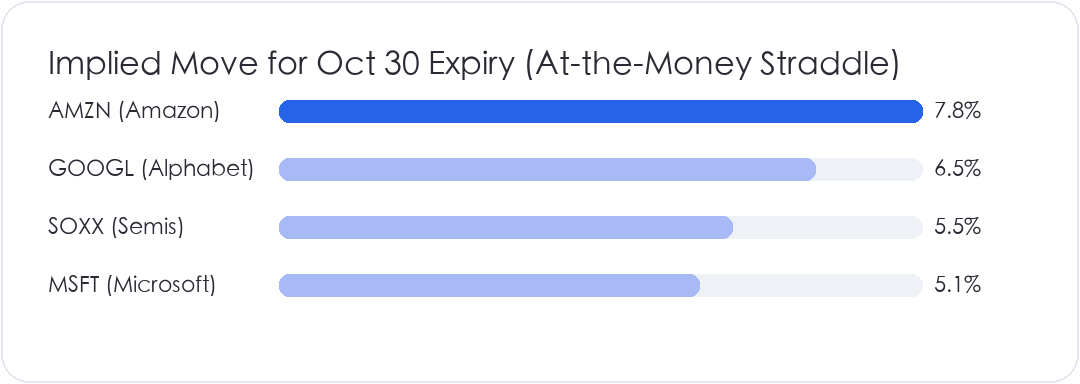
The catalysts that will resolve this straddle pricing are approaching simultaneously. The Federal Reserve's two-day policy meeting concludes Wednesday; while interest rate changes are priced out, Chair Jerome Powell's tone regarding the terminal rate and monetary liquidity will govern equity discount rates. Concurrently, earnings reports from mega-cap tech will define market direction. Microsoft (MSFT) straddles price a $27 move around $530 (±5.1%), where a pullback to $503 leaves key support at $490 intact, while a push toward $557 would establish fresh all-time highs above $551. Alphabet (GOOGL) options imply a $20 move around $315 (±6.5%), where holding above $298 is critical to avoid broader liquidation toward lower support, with overhead resistance at $335. Amazon (AMZN) options price a $20 swing around $255 (±7.8%), where clearing $265 targets $275, supported by solid demand around $235.
Beyond revenue and operating margins, the market is scrutinizing how tech titans finance their record capital expenditures—debt issuance risks steepening the Treasury yield curve, while equity financing dilutes existing per-share intrinsic value. In trading practice, as demonstrated by Broadcom's (AVGO) gap back above $325, discipline dictates cutting losses promptly upon trend breakdowns and reloading when right-side confirmation emerges, rather than holding through open-ended losses in volatile names.